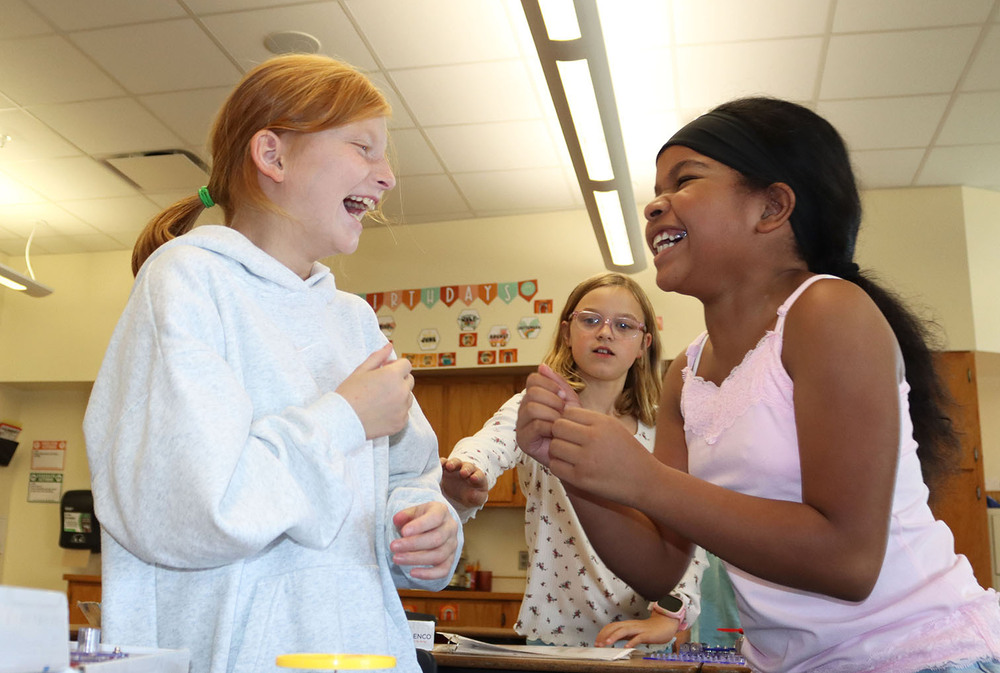
Kloefkorn Elementary School fourth graders like Hannah and Ryker connected circuits of scientific comprehension during a fun classroom activity this fall.
Eighty Cubs produced literal light bulb moments by working with interactive snap circuit kits. Kloefkorn teachers partnered with Lincoln Electric System (LES) on a lesson that taught students the fundamentals of electricity. They used safe plastic-covered pieces to connect AA batteries to a motor that powered a small fan and light.
“I like just putting everything together, because it’s such an accomplishment when it all works,” Hannah said.
“I like when we put it all together too,” Ryker said. “It’s fun to do that, and then testing it is also fun, because you get to watch it work.”
LES representative McKenzie Ferguson-Fagan said the activity was a great way to promote science, technology, engineering and math (STEM) ideas to younger students. Ferguson-Fagan is the senior specialist for education and engagement at LES and guided both 40-person groups during the afternoon. She explained the basics of electricity to the Cubs before assisting them with their projects.
“I love seeing their faces light up when something clicks or when they understand it,” Ferguson-Fagan said. “They get super excited and it makes me really happy. I think it’s a lot of fun to introduce science and electricity to them and then show them the hands-on activity. It’s really beneficial and could lead to a STEM career in the future.”
Kloefkorn Principal Shayna Cook and Lincoln Public Schools Director of Elementary Education Gena Licata said these types of lessons provide many enriching outcomes. Elementary schools across Lincoln incorporate interactive moments in their classrooms each year. Conducting a farmers market at Lakeview Elementary School, singing with “Frozen” actresses at Sheridan Elementary School and celebrating the 50th anniversary of the LPS embryology unit at Hill Elementary School are recent examples.
“Activities like this bring it to a whole other conceptual level,” Cook said. “It brings the joy of inquiry into reality for them. They’ve been really excited about doing this.”
“Hands-on learning gives students a chance to experience learning rather than just hear about it,” Licata said. “When students can build something, try it out, make a mistake and figure out how to make it work, they’re not only learning the content, they are developing curiosity, problem-solving skills and confidence. Meaningful experiences like these are something students remember long after the activity is over and can lead to deeper learning and understanding.”
Kloefkorn teachers practiced building their own snap circuits during this summer’s LPS professional learning day. LES leaders spoke about generators and electrical blackouts before giving educators a chance to work with the kits.
The activity teaches people how a power source, conductors, switches and output devices work together. Kloefkorn students snapped each piece on a plastic tray to make a closed loop. They followed instructions for connecting two batteries to a tiny direct current motor through plastic-covered conductors.
The motor, which was contained inside a metal cylinder, activated when the Cubs flipped a switch. That caused output devices like a light bulb and small circular fan to turn on.
Hannah and Ryker beamed when they successfully caused their fan to spin. They said it has been fun to learn about forms of energy such as kinetic, light, thermal and electrical in their science units. Energy is defined as a fundamental entity of nature that provides the capacity to do work. Electricity is a specific type of energy that comes from the movement of charged particles like electrons.
“It’s really interesting to hear about,” Ryker said.
The Kloefkorn tutorial was the latest example of a longstanding partnership between LES and LPS. LES employees have participated in Kloefkorn Nature Night events in conjunction with the Lower Platte South Natural Resources District, and they have worked with Lux Middle School students to build solar-powered race cars. LES and LPS have also developed curriculum lessons about energy conversion together.
Ferguson-Fagan said the Cubs picked up many key life lessons from their electrical experiences. The project gave them a chance to practice teamwork skills with their science partners, and they increased their problem-solving talents as the day went on. They could choose to try more complicated closed-loop setups after they completed their initial ones.
Ferguson-Fagan said she enjoys visiting elementary schools for activities like snap circuits. She said the ideas that originate there can spark a lifetime of scientific exploration and curiosity for students.
“I think it’s important to introduce it early, because that way they can develop a love for science and math and hands-on activities,” Ferguson-Fagan said. “It just follows them as they get older and go through school and eventually think about a future career. They can think back to their elementary school experiences, and hopefully this is something they remember that brings them a smile.”
Discover how LPS is helping students of all ages learn more about the scientific world.
Do you have a story idea? Share it with the LPS Communications Team by filling out this form!