
How do you ensure school events remain safe for people enjoying their time at local auditoriums, gyms, diamonds, pools or fields?
National trainers helped Lincoln Public Schools leaders answer that question this summer with a detailed class about crowd management strategies.
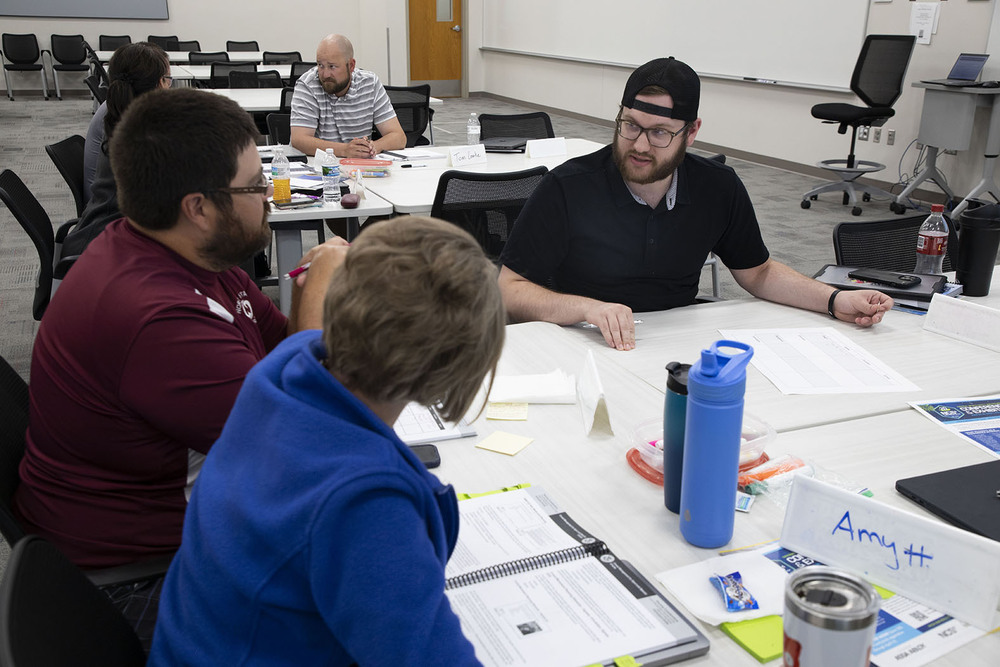
LPS athletic and activities staff members were among 24 people who attended the Crowd Management for Sport and Special Events training session at Don Clifton Professional Learning Center. Trainers Joey Sturm and Evan Ramsay from the University of Southern Mississippi’s National Center for Spectator Sports Safety and Security (NCS4) led the course.
The 2026 event marked the first time that multiple LPS music and theater personnel attended the NCS4 class. LPS Security Coordinator Kyle Poore felt it was important to include performing arts in the safety conversation. Large crowds often gather for marching band festivals, show choir contests, one-act plays and band, choir and orchestra concerts. These events illustrate the need for comprehensive, consistent and collaborative action plans.
“NCS4, to my knowledge, has never done a training where it’s been focused on the activities part of it,” Poore said. “Their focus is typically on collegiate and pro athletics, so to have our band instructors asking about ‘How does this work for me?’ and the instructors to be able to help translate it for them has been really beneficial. I’ve seen a lot of growth from the last couple of days.”
Sturm said he was impressed with the attention to detail he saw from LPS attendees. Sturm has 30 years of law enforcement experience and is familiar with K-12 education. He was a middle school teacher and coach for five years and owns both bachelor’s and master’s degrees in education.
“LPS has been a leader in sporting and special event training for its personnel,” Sturm said. “The classes have had great attendance and participation. As an instructor, it is heartening to return and witness the real-world application of concepts taught here at LPS.”
LPS Music Supervisor Amy Holloman said she was equally encouraged by performing arts leaders being invited to the safety table. Holloman has attended previous NCS4 sessions, but those trainings primarily focused on athletic events. However, performing arts concerts and contests have the same logistical and safety needs as football, volleyball or basketball games.
Holloman said the course has already borne fruit with LPS teachers. Music department chairs Gary Shuda (Southeast High School), Austin Reinke (Northeast) and Joe Albright (North Star) took the class alongside her. All three have begun to discuss new ideas for music safety measures in Lincoln.
“Our teachers have shared their perception in public is much more heightened than prior to the training,” Holloman said. “They are considering entry and exit strategies when attending concerts or public events and are thinking about changes we need to make to our own events.”
Parking lots were one of the primary points of discussion. Hundreds of cars, buses and people arrive at campus locations each year for events like the Nebraska State Bandmasters Association State Marching Festival. Items such as traffic engineering and crowd density are front and center of the safety dialogue.
“Between buses bringing in students and equipment and audience members arriving throughout the day, the parking lot is one of our largest safety concerns,” Holloman said. “Some buses don’t stay for a full-day event, so moving them safely without hitting other vehicles, equipment or patrons is essential.”
Ensuring the well-being of students and adults inside a building or stadium is also paramount. Reinke directs choral activities at Northeast and organizes “The Rock” show choir contest each winter. The annual event draws approximately 3,000 people to campus. It can lead to many pre-festival planning and design items to address.
Where is the best place for ticket takers to be? How many concession stand lines should be opened to ensure quick service? How many people should be allowed into the auditorium at once to guarantee aisles are not crowded?
“Some of our schools are upwards of 70 years old, and architecture has changed,” Reinke said. “Navigating where to place lines, how they will queue, and managing the flow of lines can be more challenging in older schools, so learning how to design events is important.”
Poore, who is co-chair of the NCS4’s national interscholastic advisory board, said having similar strategies for athletics and performing arts benefits everyone. Many people come to the same school sites to watch children, grandchildren and friends in different activities. Having one constant safety structure for music, theater and sports builds trust, reinforces event guidelines and reduces the potential for misunderstandings.
“If I’m a patron and I go watch East versus Southeast in a football game on a Friday, and then I show up on a Saturday for a band competition and the expectations are completely different, that confuses me as a patron,” Poore said. “When we don’t have consistencies, that’s where we have holes in our safety.”
Reinke said he left the NCS4 session convinced that LPS has been answering safety questions correctly for many years. He felt that positive history would help make future music and theater events even more enjoyable for patrons.
“The most valuable thing I obtained from this training was the confidence that LPS is doing things right,” Reinke said. “Many of the scenarios that were presented to us already had LPS policies in place, and for those that were the extraordinary events, the LPS staff members were able to quickly devise plans.”
Learn more about how LPS has become a national leader in safety and security initiatives.
Do you have a story idea? Share it with the LPS Communications Team by filling out this form!