
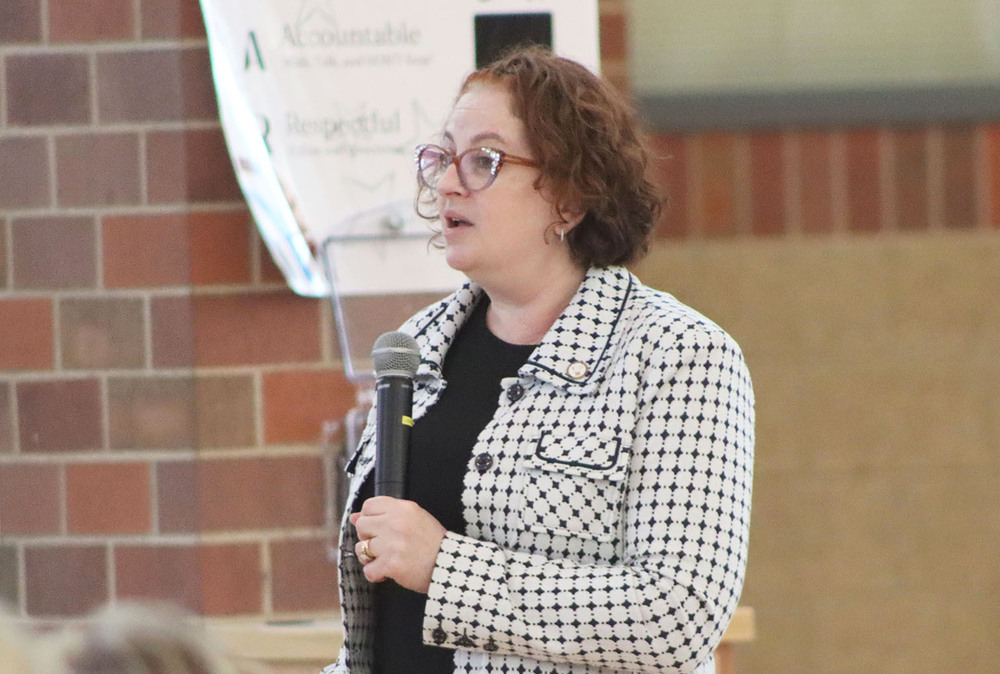
A world leader in behavioral threat assessment and management helped Lincoln Public Schools employees strengthen their safety and security knowledge this spring.
Stephanie Leite spoke to more than 100 LPS administrators and school resource officers (SROs) during a special training session. Leite is a clinical and forensic psychologist who has trained more than 10,000 people in behavioral threat assessment and management (BTAM) techniques over the past 25 years. She has worked with professionals in K-12, higher education, law enforcement and corporate settings.
Leite focused her presentation on students who are experiencing neurodiversity conditions such as autism and attention-deficit/hyperactivity disorder (ADHD). She said it is important for school employees to support these students and recognize their thought processes. This can help the adults make well-informed decisions when encountering challenging situations.
“In threat assessment and management, we always ask a few more questions, and then when it comes to students with disabilities like autism or ADHD, it’s important that we ask even a few more questions,” Leite said. “Learning how to gather good information and then process it through an autistic-friendly lens is what I’m teaching the people here to do today.”
LPS Director of Security Joe Wright said he was happy to have Leite in Lincoln. She has presented her neuropsychology and forensic psychology wisdom to conferences in North America, Europe and Australia. She is a licensed psychologist in Connecticut, New York, Vermont and Massachusetts, and she has evaluated hundreds of people in risk, competency, custody, criminal and threat assessment cases.
“Stephanie’s probably the most expert person in the world on the intersection of neurodiversity and threat management or behavioral violence prevention,” Wright said. “Just the information she gives is incredibly valuable.”
Leite provided LPS and Lincoln Police Department (LPD) staff with many details about students who have autism spectrum disorder. The neurological and developmental condition affects how people communicate, learn, behave and interact with others. Students and adults can experience a wide range of social and communication symptoms that may change over time.
Leite said closely examining statements and actions can prevent situations from escalating. For example, students with autism may say threatening words simply to leave a classroom rather than having any ill intent.
“Understanding that gives them the insight to be able to act in the really compassionate way that they want to, to help the student and understand what they’re saying,” Leite said.
Rodney Meester said those are key distinctions to make in the BTAM process. He served as the SRO at Goodrich and Schoo middle schools for the past four years. He will begin a new position as a relief SRO at all LPS buildings this fall.
“As an SRO, I recognize that the level of perceived threat in behaviors and words can differ, in part based on who those behaviors and words are coming from,” Meester said. “Additionally, there can be cultural and neurological factors involved in how students may express themselves when stressed or overwhelmed. All of that background is important to consider when wanting to accurately understand the totality of what’s going on with that student.”
Wright and LPS Safety Team Social Worker Allyson Headrick said that student-first mindset matches one of the top goals of the LPS threat assessment program: helping everyone feel hopeful and successful.
“We need kids to feel they have choices and they aren’t resigned to a single outcome,” Wright said. “If people feel they have choices and feel they have options, they’re going to feel safe, and they won’t have to make choices that are made from a position where they think they’re painted into a corner.”
“Training together as a team improves communication and effectiveness and builds a working relationship needed to ensure safety,” Headrick said. “Annual required training for all secondary administrators ensures our school safety practices and school resource officer program practices are consistent across the district and meet the goals of ensuring a safe learning environment for all students.”
Leite said she is impressed with the resources LPS has dedicated to that BTAM goal. The school district has formed a central threat assessment team that includes two school social workers, a violence prevention psychotherapist, a security coordinator, a police investigator and a security director.
LPS also contracts with LPD for SROs at all eight high schools and 12 middle schools. SROs like Meester complete rigorous training from the National Association of School Resource Officers before entering their assigned buildings. They also take additional youth-focused BTAM classes from Lincoln-based Region V Systems.
“It’s really important for parents to know that there is this robust program at LPS,” Leite said. “When the school says, ‘We’ve got this,’ they actually do, and you can trust them on it, even though it’s worrisome. There are staff around who are ready and willing to talk to them about any of their concerns.”
Meester said he was encouraged to see the large number of school administrators at Leite’s presentation. LPS Superintendent John Skretta, multiple associate superintendents and dozens of middle and high school principals and program directors were in attendance.
“Knowing that they’re getting the same training and are considering some of the same variables to protect and support students is key for establishing trust,” Meester said.
Wright said that community-based approach is helping LPS become a stronger and safer school district.
“We have a safety and security curriculum that we teach, and every administrator knows that safety and looking at issues through the threat assessment lens is part of their job,” Wright said. “It’s not someone else’s job. We’re a lot safer when all of our employees feel they’re a part of the security and safety team, and I think that has become much more of a reality over the time that I’ve been here.”
Learn more about safety and security topics at LPS.
Do you have a story idea? Share it with the LPS Communications Team by filling out this form!