
Lincoln Public Schools stakeholders learned how to create stronger communities by stretching their civic engagement muscles this fall.
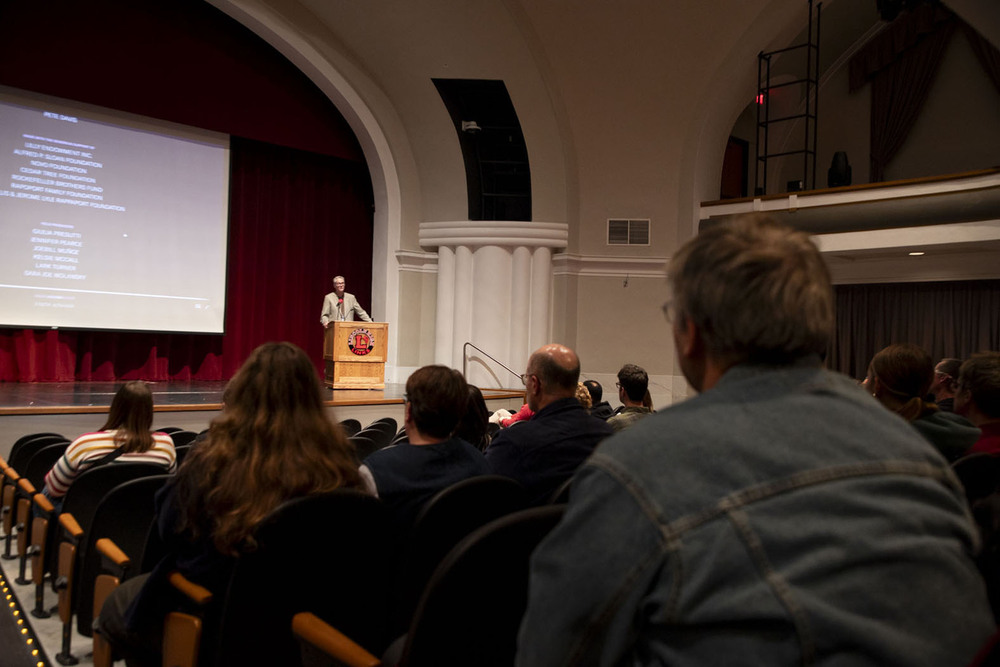
LPS students, parents and families explored how to make their city more powerful through a social networking event at Lincoln High. LPS, Lincoln Community Learning Centers (CLC) and Lincoln Community Foundation sponsored a viewing of “Join or Die,” which examines the crucial role of civic engagement in American society. The film illustrates how people, families, schools, neighborhoods and towns thrive when they build deeper connections with one another.
Lincoln High sophomore Violet said she is enjoying a more fulfilling life because of her involvement in school activities. Violet participates in marching band, concert band, show choir and theater on campus, and she takes voice lessons after her school day ends. She is also engaged in leadership seminars, community service projects and a mentorship program with the Youth Leadership Lincoln organization.
“It’s just such a good way to make friends and talk to your peers, and it’s a lot of fun,” Violet said. “And you really get to discover what you want to be like when you’re older. It helps you realize what you’re interested in and what you won’t be interested in by experiencing those activities.”
LPS Superintendent John Skretta and Lincoln CLC Director Nola Derby-Bennett said Violet’s story is a prime example of why relationships with other people matter. Event organizers wanted to encourage students and community members to develop more partnerships with the school district. They also had a goal of inspiring more students to become involved in social clubs and extracurricular activities like fine arts, sports and academic organizations.
Skretta told the audience that LPS leaders want residents to weave strong social fabrics at every school building. Lincoln Board of Education members intentionally included family and community engagement as one of the school district’s top goals in the 2024-29 LPS Strategic Plan.
“Family and community engagement is so important that it’s one of the four pillars of our strategic plan, and we have targets around that that specifically say and think about this,” Skretta said. “And you all are doing this. I mean, your presence here is a visible manifestation of the importance of that social contract theory and the commitment back to community.”
Derby-Bennett said she was thrilled with the turnout. She felt everyone was inspired to create more bonds inside and outside of school.
“I think this was a really great opportunity for our school district to say we do want family and community to be a part of the work that we’re doing,” Derby-Bennett said. “We are developing your future neighbors, and we want you to be a part of their development and their experience.”
The film was based on the work of American social scientist Robert Putnam, who spent decades researching the value of social capital in the country. Putnam determined that social networks provide significant benefits such as increased trust with neighbors, higher cooperation levels among groups and more feelings of companionship.
Putnam also noticed that Americans were becoming increasingly isolated. He discovered that fewer people were involved in parent-teacher organizations (PTO), sports leagues and civic and charitable groups. Attendance at religious worship places and informal group meetings like picnics and dinner parties had also declined.
Lincoln resident Clay Cressler said it is critical for schools to have strategic plans for family and community engagement. He has worked in several cities and currently teaches in the School of Biological Sciences at the University of Nebraska-Lincoln. He has noticed that the success rate of school districts is directly tied to their ability to generate strong social links.
“In every place I’ve lived, and I’ve lived in a bunch of places, you can tell that the schools that thrive are the schools that have the most involved parents and the most involved communities, and the schools that struggle are the ones where that connection is not as strong,” Cressler said. “And so, figuring out how to get people to be involved and engaged seems essential.”
Derby-Bennett said events like the film screening are one way to foster those connections. She was glad people could spend time after the movie sharing conversations and ideas about social involvement.
“The movie itself generates a lot of dialogue and a lot of things to think about,” Derby-Bennett said. “But then, I think we just kind of wanted to give people a little bit of a nudge of like, okay, now think about how that applies to you. How do you move forward in your community? How do you invite people to join? And so, that was kind of the impetus.”
Violet has already noticed benefits from participating in educational activities. She said she is more confident with her public speaking skills and has developed additional leadership qualities. She has also met more people because of her willingness to try new experiences.
Skretta urged other LPS students to follow Violet’s example.
“The time to lead is not some unseen future horizon,” Skretta said. “It’s now. We need your voices and involvement and engagement now.”
Skretta also felt the film reinforced the importance of community participation in schools. He said civic engagement will help LPS students build stronger academic and social muscles throughout their educational journeys.
“If we do not have active, engaged families, and we do not have a community that rallies to support the school in myriad ways, we do not achieve our objectives,” Skretta said. “And those objectives speak to the heart of what we do. It’s about young people. It’s about empowering them to achieve their fullest potential.”
Discover examples of how LPS students and staff are applying community engagement lessons through these Get Involved stories.
Do you have a story idea? Share it with the LPS Communications Team by filling out this form!