
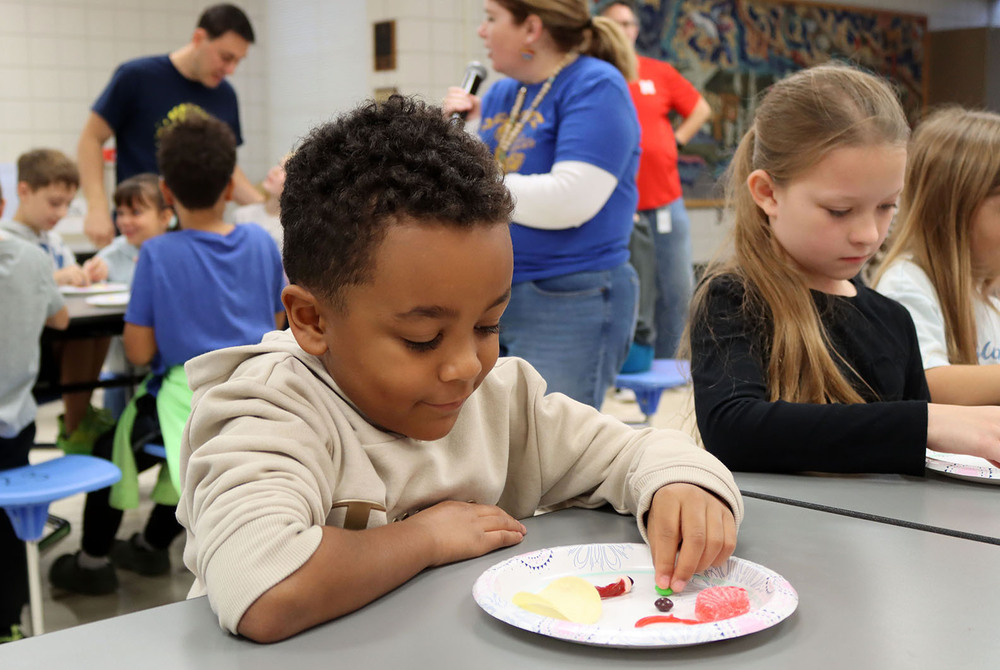
Beattie Elementary School third graders listened to educational sound waves this fall during an activity about the human ear.
Several dozen Bobcats learned how the ear functions during a 45-minute lesson. Holly Flanagan-Matzen, who is a teacher of the deaf and hard of hearing, led a discussion that focused on ear parts like the cochlea, ossicles and tympanic membrane. Students then reinforced their learning by building their own edible ears with pieces of candy.
Beattie third graders Evelyn and Roger said they liked the activity. Evelyn felt more knowledgeable about the ear and how to protect it during her lifetime.
“It’s really important because you get to know how the ear works,” Evelyn said. “If something happens to your ear, then you know what to do to try to make it better.”
Roger said including the edible ear in the day’s lesson made the information come to life. He and his friends formed their ears by moving licorice, mints and small candies into their proper places. Everyone’s paper plates soon included colorful representations of ear bones, cartilage and tubes.
“I liked making the edible ear,” Roger said. “It was fun to build and I liked putting the candy together.”
Beattie students Zai and Santi came beforehand to help Flanagan-Matzen prepare for the event. They passed out candy to their friends and watched everyone enjoy the day. Zai felt the Bobcats would retain more of the information they learned by making their own ear.
“The candy shows the different parts of the ear,” Zai said.
Flanagan-Matzen began teaching at Lincoln Public Schools more than a decade ago. She arrived at Beattie this year and asked if she could present the edible ear seminar to the Bobcats. The activity dovetailed with an Amplify CKLA curriculum unit called The Human Body. Third graders have been learning about the body’s skeletal, muscular, nervous and auditory systems.
“I’ve found when doing this activity that it truly does teach students the parts of the ear,” Flanagan-Matzen said. “I’ve taught it at other LPS schools before, and I’ve found that whenever I go back to those schools, there will be kids who say, ‘You’re the person who taught us that the cochlea was whatever candy I had that year.’ They do truly remember it.”
Students who are deaf or hard of hearing like Zai and Santi have attended many presentations with Flanagan-Matzen to help spread awareness to their classmates. Flanagan-Matzen said those interactions make a difference for everyone.
“Sometimes they’re a little shy about their hearing loss or their equipment, so doing this gives them that self-confidence,” Flanagan-Matzen said. “Teachers and principals have always been really embracing of this for that reason.”
The Bobcats discovered that the ear has three main parts. The outer ear is the visible part of the organ on the side of the head. It is formed of ridged cartilage and skin and contains glands that secrete earwax.
The eardrum separates the outer ear and middle ear. The eardrum, also called the tympanic membrane, includes three tiny bones – the malleus, incus and stapes – that are often referred to as the ossicles. The ossicles move sound vibrations from the middle ear to the inner ear.
The middle ear is also where eustachian tubes are located. These are connected to a person’s throat. When someone swallows, sneezes or yawns, the eustachian tubes open up to equalize the air pressure in the ears.
After sound vibrations travel through the outer and middle ear sections, they reach the inner ear. It contains a hearing organ called the cochlea, which has two fluid-filled chambers lined with tiny hairs called stereocilia. The fluid causes the tiny hairs to vibrate, which sends electrical impulses to the brain through the auditory nerve. The brain then interprets the electrical impulses as sounds.
The inner ear also includes semicircular canals that are responsible for balance. They tell the brain which direction the head is moving. The vestibular nerve transfers this information to the brain, and the brain sends signals to muscles to keep people balanced.
Roger said he and his friends had discovered a lot of good information about the ear’s anatomy.
“I learned that the hairs in the cochlea are what send messages to the brain,” Roger said.
After creating their edible ears, students asked Flanagan-Matzen about sign language interpreters, how hearing aids work and how they could keep their hearing. Flanagan-Matzen also walked by each cafeteria table and showed students her own hearing aids.
“Make sure you protect your ears whenever you go to a concert or mow the lawn or do anything that’s really, really loud,” Flanagan-Matzen told them. “It’s really important to do that.”
Flanagan-Matzen said the edible ear activity is one of many ways the school has embraced students who are deaf or hard of hearing. Multiple pupils have learned American Sign Language to communicate with classmates like Zai and Santi. The Bobcats also do a “silent round of applause” at schoolwide assemblies by raising their hands and shaking or twisting them.
“Beattie has developed such an inclusive environment for all our students who have hearing loss,” Flanagan-Matzen said. “It’s exciting to see a random classroom teacher tell our students, ‘Good morning’ or ‘Good work’ without the use of an interpreter.”
Flanagan-Matzen said she enjoys leading the activity because of its lifetime benefits for LPS students.
“It’s turned into something that really helps the kids,” Flanagan-Matzen said. “It’s great.”
Discover how LPS supports students through organizations like the Southeast Nebraska Regional Program for Deaf and Hard of Hearing.
Do you have a story idea? Share it with the LPS Communications Team by filling out this form!