
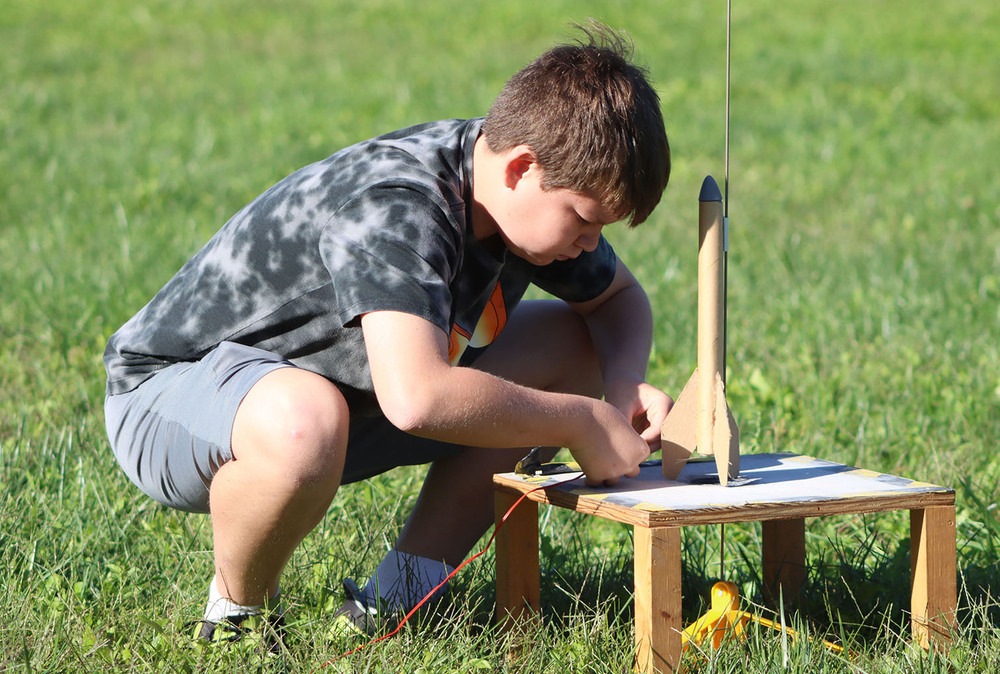
Mickle Middle School eighth graders displayed evidence of their engineering knowledge this fall when their model rockets cruised through blue skies.
Skilled and technical sciences (STS) students enjoyed watching their cardboard projectiles launch off a wooden platform and parachute safely back to the ground. The activity capped a weeklong project that taught them principles about flight design, battery power, aerodynamics, rocket circuitry and machine safety.
Autumn smiled as her rocket soared off a four-legged wooden platform into the air outside the school building. She safely stood 20 feet away from the platform while pressing a button on a remote-controlled ignition device. She was pleased with how her first attempt at building a mini missile had gone.
“I was happy,” Autumn said. “It went pretty high, and I didn’t think it would.”
Lathan also felt the rocket launching project was a good experience. He completed his model in Mickle’s STS workshop in just two days. He then joined his classmates for the capstone event of the rocketry unit.
“I like building things,” Lathan said. “Certain parts were kind of hard, but overall, it wasn’t bad to do at all.”
STS teacher Brett Dorcey said the rocket launching exercise is one of many interactive lessons students benefit from during their middle school years. They work on 3D modeling projects, build mousetrap-powered race cars and construct bridges out of multi-filament material. He said those activities are both educational and appealing for the Missiles.
“Getting to launch a rocket is always super exciting for them,” Dorcey said. “The hands-on projects are the bread and butter of my classroom. It’s really what makes the kids excited.”
Students began their assignment by learning how to follow technical instructions in their workshop. They built hollow cylinders that featured three wings near the base. They packed parachutes inside the top of their rocket and inserted small engines in the bottom. The rockets were powered by black powder and batteries for ignition.
Lathan said he was interested in the project’s engineering components. Dorcey explained to the class how the rocket engines operated and how their labels indicated the amount of available power. He also showed them how to safely connect their wires to the rocket’s base.
“I learned how batteries and engines can help you,” Lathan said. “There was a B4-4 and an A4-4 engine that we could use, and they had different types of power to help your rocket.”
Autumn said she enjoyed cooperating with other eighth graders during the morning. She spent several minutes at the beginning of class helping a fellow Missile fold and pack his parachute inside his rocket. She then helped another classmate glue down a section of their rocket before it reached the launchpad.
“You got to talk with them and explain to everyone how you did it, and then you got to see how high everyone’s rocket went,” Autumn said. “That was fun.”
Dorcey said the STS lessons are designed to reinforce important personal skills such as teamwork, patience and following directions. The enriching activities also build on each other throughout the year. Students watched a short documentary about the recent Artemis II mission several days after launching their rockets. The space exploration material connected with aviation, engineering and woodworking concepts that students can further explore in high school.
“The STS program at the middle school level is set up to be a way to get lots of experiences that will lead into classes at the high school level,” Dorcey said. “We’re highlighting the programs that are offered at the high schools.”
Mickle students like Autumn and Lathan will be able to choose from a wide range of high school STS subjects. These include architecture, engineering, woods manufacturing, welding, machine tool manufacturing, robotics, automotive repair and aviation. These are part of a broader group of career and technical education (CTE) opportunities available throughout the school district.
Dorcey said he also wants to teach the Missiles about the wide range of available STS careers. For example, the space industry features many positions for scientists, engineers, technicians and communications professionals. Plasma physicists work hand in hand with atmospheric scientists, mechanical engineers, avionics technicians and space photographers to make sure projects are successful.
“Even if you’re not a head engineer at NASA, they still need people who can turn wrenches and who understand how to build things,” Dorcey said. “There are a lot of possible careers.”
Dorcey said he was pleased with the amount of focus and concentration students displayed throughout the launching process. He felt their engineering experiences could help their confidence soar as high as their rockets.
“With all of the projects we do, I hope they get a sense of ‘I can do something that I didn’t expect,’” Dorcey said.
Discover more about career and technical education opportunities available for LPS students.
Do you have a story idea? Share it with the LPS Communications Team by filling out this form!