
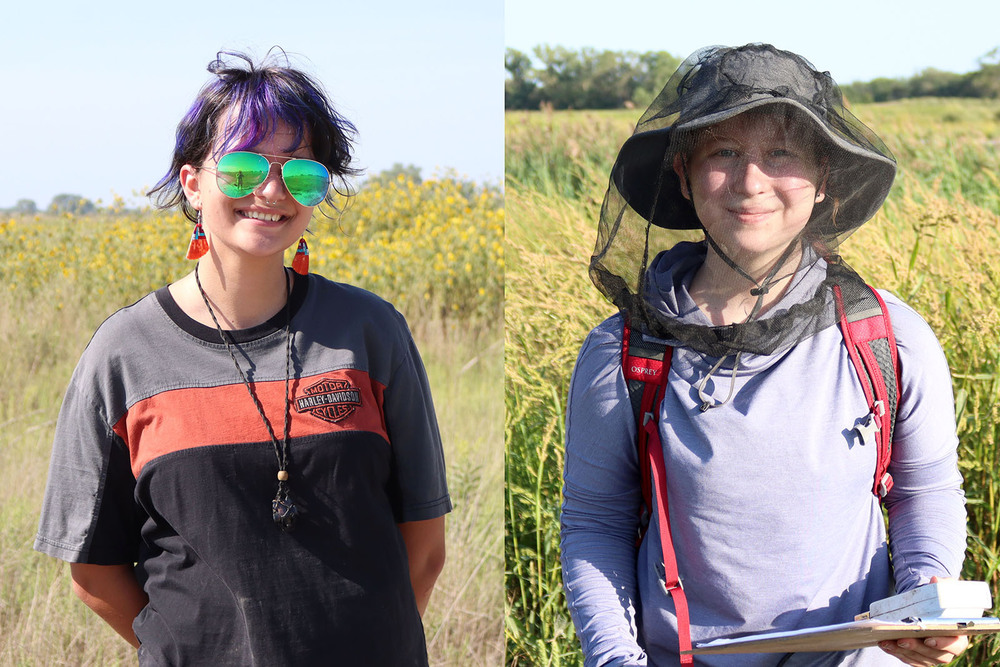
Two Science Focus Program students are gaining exceptional scientific knowledge by studying the habitat of one of the world’s rarest insects.
Seniors Amalia and Lillian are learning more about the Salt Creek tiger beetle during their senior capstone projects. Amalia is tracking where the endangered insects lay their eggs at Arbor Lake, and Lillian is examining if the restoration of Marsh Wren Saline Wetland is creating more salty soil for the bugs to thrive in.
Amalia and Lillian both said they are grateful for the chance to investigate areas of interest for them. Both spent time in early September scouting local saline wetlands for clues to their Salt Creek tiger beetle questions.
“It has been influential for me to conduct in-depth research as a high schooler,” Amalia said. “Having the ability to conduct this project opened up knowledge and opportunities that expanded my view of the topic. Working with Nebraska Game and Parks has been extremely helpful with resources that would otherwise be difficult to acquire or completely unavailable as a high school student.”
“I believe that having the opportunity to do this type of in-depth research as a high schooler is very important,” Lillian said. “For me, this project matters a lot because I’m getting to apply the things I’ve learned in chemistry and biology classes to a real-life issue that people around the world are also working on.”
Science Focus Program Administrator Lindsey Roy said the independent ventures teach seniors like Amalia and Lillian many valuable lessons. They gain confidence by taking ownership of their work from start to finish, and they discover how to compile, record, and analyze data using systematic methods. They also begin to realize how they can play important roles in the larger theater of scientific research.
“It’s incredibly satisfying to see seniors take charge of their own research projects,” Roy said. “Watching them move from ‘How do I get an A?’ to ‘What are the broader implications for answering this question?’ is simply incredible. That evolution happens as they learn to navigate setbacks, trust their ideas and learn from experts.”
Both projects are highlighting how hands-on learning helps Science Focus Program students reach their goals. Seniors weave all of their knowledge together in yearlong capstone projects. They choose their topics, plan the scope of their investigations and arrange times for field research and interviews.
Amalia and Lillian both selected the Salt Creek tiger beetle because of its endangered status. University of Nebraska-Lincoln researchers counted 374 adult beetles in 2012, but those numbers dropped below 200 in both 2024 and 2025. The insect’s only known habitat in the world is found in saline mud flats and exposed mud banks with salt deposits in Lancaster and Saunders counties.
Amalia spent one afternoon scouting potential oviposition sites (where eggs are laid) on a dry lakebed along 27th St. north of Interstate 80. She aims to determine if there are enough resources for beetles to survive and reproduce during their two-year life cycles.
Amalia uses a 100-square portable grid to map where the beetles have formed their burrows on the lakebed each week. This system helps her track how close the small mounds are to vegetation and neighboring insects. She can then determine how much the beetles consider these factors when they choose their larval sites.
Amalia said it is encouraging to join the conservation effort in high school. Scientists will use her data to plan restoration efforts for the entire Arbor Lake ecosystem.
“It is inspiring to be making such a tangible impact in the research field,” Amalia said.
Lillian spent one evening moving through several muddy sections of Marsh Wren. She is investigating how saline groundwater drip and sprinkler irrigation systems are impacting soil on the marsh’s eastern and western sides. She dug multiple holes with a shovel before placing a sensor in them. She then took readings from an electronic sensor to determine the soil’s characteristics.
Lillian visits the marsh twice each week to calculate how time, depth, distance and varying precipitation affect salt levels in the ground. This information is crucial for evaluating how the irrigation systems are working.
“Salty soil is what makes saline wetlands such as Marsh Wren unique ecosystems that are capable of supporting endangered species such as the saltwort plant and Salt Creek tiger beetle,” Lillian said. “Therefore, I hope that my project can help identify trends in the soil conductivity that suggest whether the restoration of the wetland is being successful, and in general help create a better understanding of the conditions there.”
Roy said she is always impressed with the cleverness she sees from seniors in the focus program. She said their capstone projects give them an important head start on their future goals. Lillian plans to learn more about earth science as a geology major in college, and Amalia intends to major in biology and environmental conservation after high school.
“These seniors will often surprise themselves with what they are capable of when they take ownership of their learning journeys,” Roy said. “Seeing them initiate rigorous, meaningful research and speak about their findings with confidence is a powerful reminder of just how ready they are for whatever comes next.”
Ready to customize your high school experience at LPS? Explore our Science Focus Program.
Do you have a story idea? Share it with the LPS Communications Team by filling out this form!