
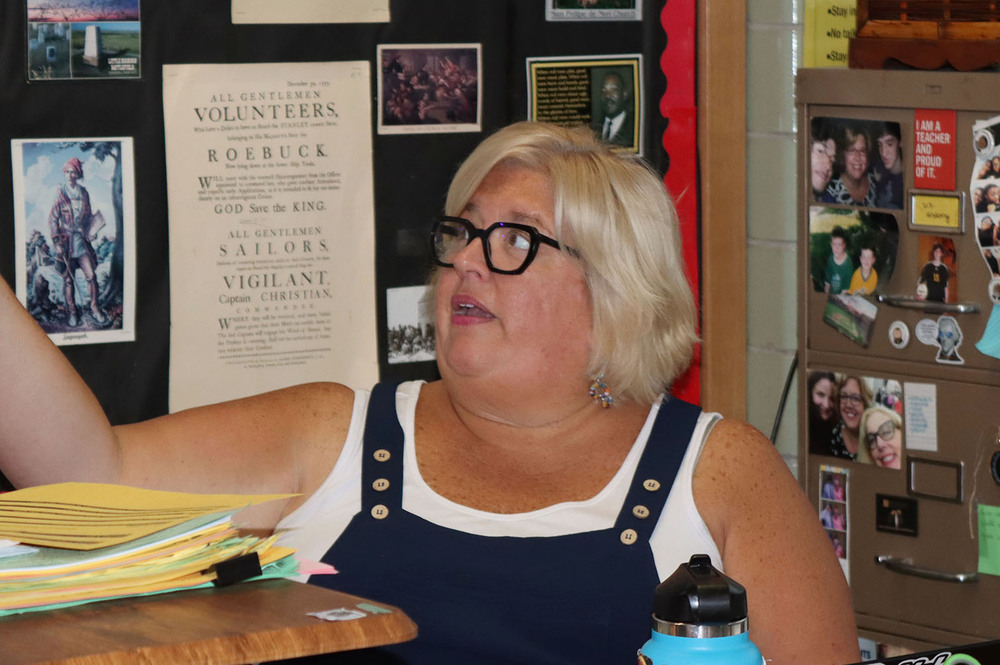
Becky Boswell, Tony Quattrocchi, David Peters and Leland Jacobs remember exactly what they were doing when the 9/11 attacks happened 25 years ago.
The four Lincoln Public Schools educators spent that day helping students understand and process the tragedy as it was unfolding in New York City, Washington, D.C., and Pennsylvania. They are among 13 current LPS social studies teachers who were leading classes in Lincoln on Sept. 11, 2001.
All four are continuing their important mentorship work today. They are showing their 2026 classes how events like 9/11 have affected the course of history. They are also equipping students with valuable skills that allow them to analyze complex issues facing human societies.
Boswell and Quattrocchi both have vivid memories of the morning. Boswell was walking down a hallway at Lefler Middle School when she learned that both World Trade Center towers had been struck by airplanes. Quattrocchi, who is the current social studies department chair at North Star High School, was leading classes at Southeast High School when the news reached his room.
“I know I went with several other teachers and found a TV, because at that time we did not have computers or TVs in every room,” Boswell said. “It was sketchy getting news, but I remember there was an announcement at some point informing everyone what was going on. Students and staff were nervous and many of us just wanted to get home and be with our families.”
“For the rest of our classes we threw out the lesson plans for the day and simply turned on the TV coverage and watched,” Quattrocchi said. “Students were very quiet and all watched attentively. A few had questions, but most were quiet throughout the day. The next day, we watched more coverage and had some discussion.”
Peters said his classes were full of the same reactions. The Southeast High School teacher said many Knights sat in stunned silence as the images were broadcast.
“There were no answers yet as to who or why, and surprisingly few questions from the normally inquisitive students,” Peters said. “We were in shock and simply didn’t have the words.”
LPS K-12 Social Studies Curriculum Specialist Jaci Grimes said every school building recognizes Patriot Day on Sept. 11. Many social studies teachers also lead mini-lessons about 9/11 during the day. They use resources from places such as the 9/11 Memorial and Museum and the Library of Congress to help classes learn about the event.
All teachers base their lessons and discussions on the goals of the LPS social studies curriculum. Classes examine topics such as history, geography, economics and psychology to become informed citizens. They also become skilled in understanding the human story across time at local, national and international levels.
Jacobs was beginning one of his United States History classes at Northeast High School when everyone learned about an explosion at the Pentagon. He said 9/11 provided students with an example of why it is important to rely on verifiable information when assessing a situation.
“I think one of the biggest challenges that day was that we were receiving all this unfiltered information from the various news programs. They just went on the air and started sharing whatever information came into their possession,” Jacobs said. “So, I had to have a discussion with my students about what we knew for sure, what needed to be verified and what we didn’t know. Of course, I think it turned out that there was a great deal that we didn’t know that day.”
The attacks also illustrated how historical events can cause both short-term and long-term effects. Quattrocchi said he and other students noticed the absence of airplanes in the sky during athletic workouts on Southeast’s track. They immediately realized why this was happening from a societal standpoint.
“This was so unusual,” Quattrocchi said. “I believe this continued for at least the next week. No airplane flights, no streaks of white where you would normally see airplane streaks as they would fly over Nebraska.”
The event also caused many long-term changes in American society. Airports established new safety protocols for passengers to complete at Transportation Security Administration checkpoints after 9/11, and public event organizers implemented security measures such as metal detectors and bag checks at concerts and games. New commercial products such as travel-sized toothpaste and deodorant containers emerged, and the American government established the Department of Homeland Security.
Jacobs said these outcomes show why patience, flexibility and evenhanded evaluation are critical social studies skills. This is especially important for students who are living in an age of instant information.
“It takes time, often years or even decades, to fully process large events and understand their causes and consequences,” Jacobs said.
No current LPS students were alive when 9/11 happened, which makes teaching and learning different from 25 years ago. Students must interpret the event through historical lenses instead of their own personal memories.
“It’s incredibly important for kids to understand the impact of that day on U.S. history, but it’s also hard for them to comprehend because they weren’t alive for it,” Boswell said.
Quattrocchi said 9/11 has remained a key moment in American history for his classes to understand and process today.
“Students are always very curious about what happened,” Quattrocchi said.
Learn more about the goals of the LPS social studies curriculum.
Do you have a story idea? Share it with the LPS Communications Team by filling out this form!