
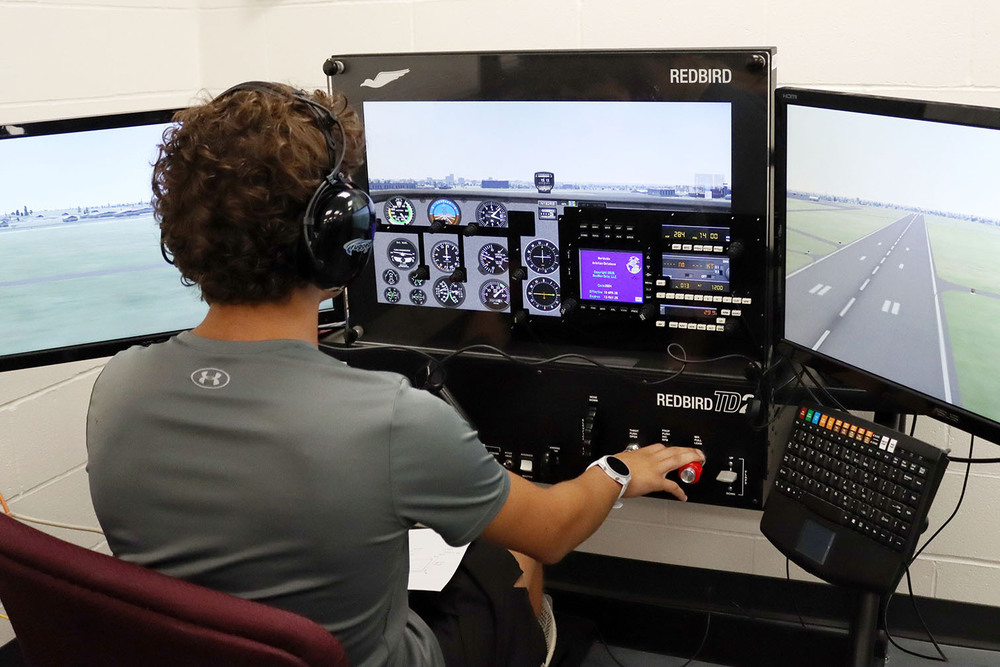
Cutting-edge technology is giving Aviation and Technical Education Focus Program students a crystal-clear vision of their future careers.
Thirteen future pilots are using state-of-the-art flight simulators to hone their skills at North Star High School. Students in the Advanced Aviation Flight course learn how to maneuver airplanes through turbulent weather, maintain proper altitude above mountains and gauge how much fuel is needed for long-distance trips. Their focus program experiences will put them on an accelerated track toward obtaining their private pilot licenses.
North Star juniors Samuel and Jamiul said they have enjoyed completing assignments on the high-tech simulators. The sophisticated screens, realistic cockpit instruments and detailed travel scenarios are giving them valuable flight experiences without ever leaving the ground. Both would like to become pilots after they graduate from school.
“It’s great being able to practice flights and run-ups and everything that I would be able to do in a real airplane,” Samuel said. “It’s nice having the option that if I mess up, it won’t cost a whole lot.”
“If you want to be a pilot, it’s a great way to know the systems, know the airports and know everything you want to do,” Jamiul said. “You’re not getting the physical G-force itself, but you’re getting everything else. It’s a good way to start your journey if you’d like to fly airplanes.”
Aviation and Technical Education teacher Eric Lubker said the simulators have been “a huge gamechanger” for Lincoln Public Schools students. They take beginning lessons on the Redbird Jay Velocity Edition and TD2 machines in their Aviation 1 and Aviation 2 courses. They then use them as a main catalyst for instruction in Advanced Aviation Flight.
“The people who came here to teach me about the simulators, the Redbird representatives, said that we have a better facility here than most community colleges across the nation,” Lubker said. “It’s amazing.”
The 13 flight simulators are placed around the perimeter walls of one of the focus program’s classrooms. The TD2 versions have three screens and multiple cockpit controls, and the Jay Velocity Edition models feature one screen with handheld steering and altitude devices.
Each simulator station also includes headphones and microphones that are linked to Lubker’s main speaker system. The wireless connections allow Lubker to serve as an air traffic controller in front of his two computer screens. He can watch the progress of all 13 students simultaneously, and he can give individualized radio instructions to people who may need assistance.
Jamiul said he was amazed when he used one of the simulators for the first time last year.
“I was fascinated by it,” Jamiul said. “I didn’t know that LPS had this system, so I’m really, really grateful to be here.”
The Advanced Aviation Flight curriculum gives students a wealth of important information. They learn how to perform pre-flight checks, conduct air traffic control operations and establish safe flight patterns. They also investigate how weather affects aviation both on the tarmac and in the skies.
The Navigators begin each class by checking the current temperature, wind speed, humidity level, barometric pressure and visibility distance. They also listen to aviation traffic advisories that provide real-time information about flying conditions at local, regional and national airports.
After their initial assessments, Lubker gives students the daily flight pattern he would like them to practice. His instructions include mean sea level (MSL) and above ground level (AGL) measurements and a checklist of activities like lowering and raising airplane flaps. Each person draws the flight patterns on pieces of paper to use as references when they operate the simulators.
Each computer contains a large database of subject material for students to focus on. They can fly through mountain passes, land airplanes on islands and make on-the-spot adjustments for thunderstorms, fog and strong winds. Lubker can also add impromptu elements to each simulation to help them learn how to cope with unforeseen events.
Samuel said all of those ingredients create an exceptional aviation learning experience.
“It’s more realistic than I would have expected, for sure,” Samuel said.
Lubker said people in the aviation industry are fully aware of the pipeline of future pilots emerging from LPS. Schools like the Ignite Flight Academy in Lincoln and the University of Nebraska-Omaha Aviation Institute have both established close connections with the focus program. Multiple other colleges across the Midwest are also potential landing spots for graduates.
“The flight simulator lessons alone will put them 30 percent ahead on their private pilot license path,” Lubker said. “When they go to someplace like Ignite or UNO, they already know what they need to be doing while they’re in the cockpit.”
Lubker said it is rewarding to remain connected with former students who are continuing their aviation adventures. One graduate is planning to become a pilot in the United States Navy, and a second alum is currently enrolled in flight school at UNO. The UNO student is planning to visit the focus program later this year to encourage the Navigators about their future prospects.
Lubker said those stories are proof of the crystal-clear impact that the flight simulators are having on students in his classroom.
“I enjoy watching the students grow into pilots,” Lubker said. “It’s even more enjoyable to watch them leave this class and become pilots.”
Discover more about the exciting opportunities students have in Aviation and Technical Education courses.
Do you have a story idea? Share it with the LPS Communications Team by filling out this form!