
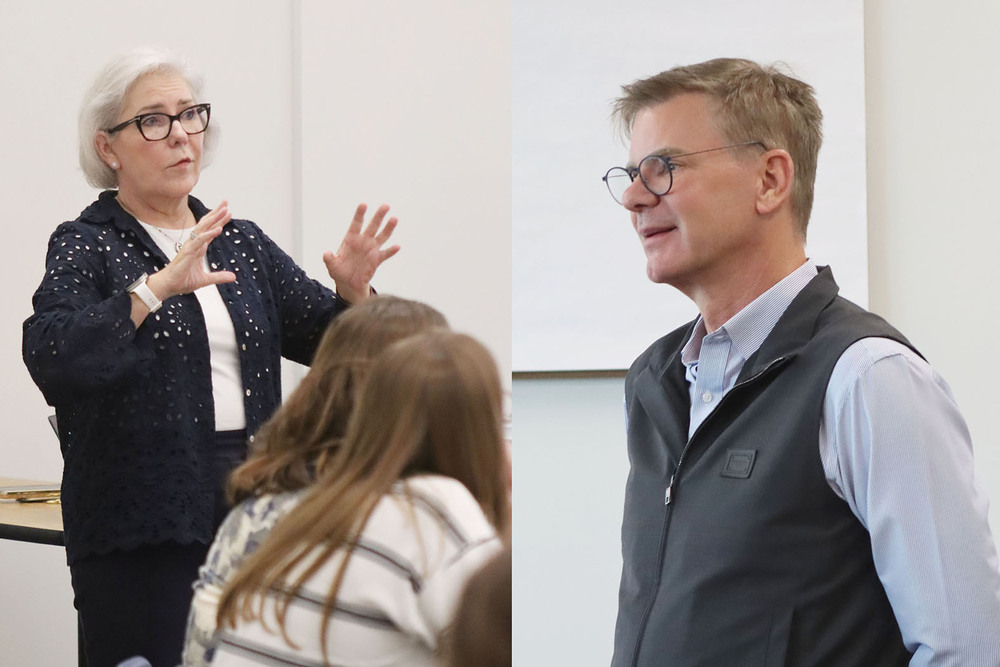
Two pillars of the international literacy community offered words of wisdom to Lincoln Public Schools staff members this summer.
More than 30 English Language Arts (ELA) teachers gathered at Standing Bear High School for a daylong event with Doug Fisher and Nancy Frey. The San Diego State University staff members are considered among the world’s foremost experts on literacy development.
Fisher served as president of the International Literacy Association in 2017-18 and has produced multiple books, videos and journal articles. Frey is a member of the California Reading Hall of Fame and has published many research articles related to literacy, school leadership and effective instruction.
Goodrich Middle School teacher Ella Roth said Fisher and Frey are on the cutting edge of literacy scholarship. They have remained in tune with the daily needs of ELA teachers by being in the classroom themselves. Both lead high school courses at the Health Sciences High and Middle College, which is part of the San Diego Unified School District.
“These speakers are sort of like legends in this field in terms of the research that they have done and the strategies that they have come up with and shared with different educators for promoting literacy,” Roth said. “It’s not often that you have a researcher who has been in the field for more than 20 years sharing TikToks about modern students and their experiences. That was really refreshing to see.”
The event was one of three professional learning sessions that middle and high school ELA teachers will participate in during the year. LPS Secondary ELA Curriculum Specialist Sara Danielson said the activities are part of an ongoing strategy to promote literacy for all students in grades 6-12.
“Secondary ELA has been focused on growing teachers’ knowledge base on adolescent literacy for the past few years,” Danielson said. “Dr. Fisher and Dr. Frey are experts who will help us support teachers as they work to improve reading comprehension outcomes across the district.”
Fisher said it was encouraging to know that LPS teachers and administrators have set those types of literacy goals.
“We want kids to keep learning, so we as teachers have to keep learning too,” Fisher said. “It’s an important process we go through. When we grow our own knowledge base about subjects like literacy, we help students in the classroom.”
Roth said she was pleased to hear specific tips from Fisher and Frey on ways to continue that positive trend. They shared how they systematically teach vocabulary to help all students with reading skills. Their plan includes a detailed framework for daily ten-minute literacy activities within classrooms. Teachers can build on the mini lessons throughout the week to help students reach core reading comprehension benchmarks.
“These are basic concepts, but the strategies that they recommended offer a new twist for us to present it to students in a way that is maybe more enjoyable for them,” Roth said.
Frey also reaffirmed the importance of teachers developing strong reading relationships in their classrooms.
“I think some of it is just tying back to what their interests are and what their reading habits are,” Frey said. “Even being able to say things with students like, ‘Oh, I was reading this article the other day,’ or ‘I was reading this blog the other day, and here’s what it said.’ What you’re doing is building that habit among young people that this is what we do. We read.”
Southwest High School teacher Lori Nagakawa and Lincoln High teacher Marisa Zornes said those ideas are why they were thrilled to learn from both Fisher and Frey. LPS educators participated in a lunchtime book club discussion after the morning presentation. They also attended smaller breakout sessions with both researchers in the afternoon.
“They’re some of the most respected names as far as literacy and working with kids and helping struggling students to achieve better,” Nagakawa said. “Some of the things they’ve done in their school district are phenomenal, and as an older teacher, it’s nice to be reminded of some of these things.”
“I think LPS has always invested in teachers, but to bring in these two names, I think, just further shows how much LPS values its teachers,” Zornes said. “When I think about that strategic plan, we talk all the time about staff well-being, and this is one of those things that reaffirms that.”
Nagakawa said the community aspect of the professional learning session was also valuable. Teachers shared classroom ideas with each other and built important friendships throughout the day.
“To have some time to do that is really significant,” Nagakawa said. “It’s great to hear what other buildings are doing differently than what you might be doing. It really sparks creativity, which is always a good thing.”
Frey said she was impressed with the sophistication she saw from LPS teachers and administrators. She was confident that Lincoln students would receive high-quality literacy instruction throughout the 2026-27 year.
“I love being able to have sessions like this because they have such good ideas,” Frey said. “There’s an expression that the answer’s always in the room. Being able to be in lots of different rooms with different teachers, I always come away with a bunch of new ideas.”
Learn how secondary ELA classes are helping LPS students become lifelong readers.
Do you have a story idea? Share it with the LPS Communications Team by filling out this form!