
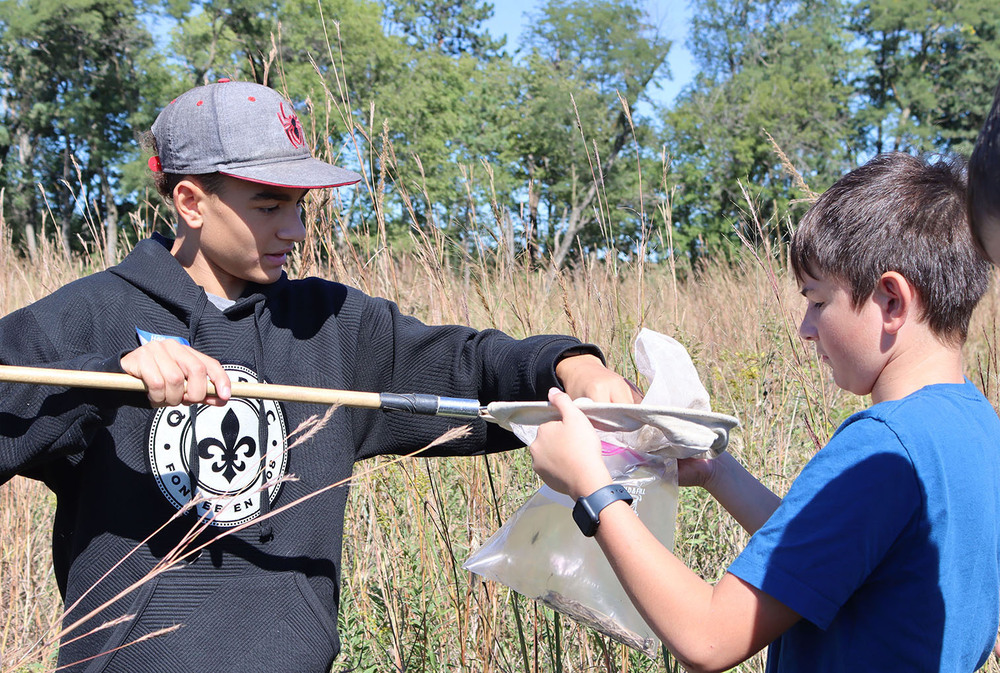
Lefler Middle School seventh graders added the words entomology, botany and ornithology to their vocabularies by going on tallgrass prairie adventures this fall.
The Lions discovered more about the natural world during trips to Spring Creek Prairie Audubon Center. They became more familiar with the job descriptions of scientists who study birds (ornithologists), plants (botanists) and bugs (entomologists) at the site, which features 1,160 acres of pristine wilderness. They learned that hummingbirds fly in every direction, marveled at silk-weaving spiders and recorded how many plants grew in areas the size of a hula hoop.
Bianca and Leo both gave five-star reviews to their expedition. They said it was eye-opening to track the variety of species in the seven-foot-high grasses. Students used large bug nets to collect everything from short-horned grasshoppers to stream cruiser dragonflies. They then talked about the microhabitats that all of the small creatures live in.
“I liked seeing how many bugs you can catch just by doing five swoops with the net,” Bianca said. “You couldn’t see them before, because they were so camouflaged and hidden in the grass, but they were there.”
“There are so many of them,” Leo said. “You catch so many more of them than the big ones, even though we notice the big ones a lot more.”
Bianca said it was fun to soak in a large amount of information. Jason St. Sauver, the center’s senior manager for education, led one lesson about the differences between insects, arachnids and other types of invertebrates. He told the students that insects and arachnids both have hard outer shells, but insects have six legs and arachnids have eight legs.
“Some other bugs have eight legs and look like a spider, like a daddy longlegs, but they aren’t actually spiders,” Bianca said. “I thought that was really interesting.”
University of Nebraska-Lincoln educator Bailey Feit and LPS seventh grade science teacher Haidyn Wendlandt said those moments are why the outdoor trips are helpful. Feit coordinates the LPS “FEWS” (food, energy and water systems) partnership as the UNL College of Agriculture and Natural Resources (CASNR) education and career pathways coordinator. She also chairs the Spring Creek Prairie Audubon Center Stewardship Advisory Board, which includes community members from a variety of state and local organizations, including LPS.
Located southwest of Lincoln near Denton, the park is one of the largest tallgrass prairies left in Nebraska. It includes four miles of walking trails that allow visitors to see 370 plant species and 240 types of birds.
“It brings their learning to life,” Feit said. “They can hear about it in the classroom, but it’s still very conceptual until they see it in person and experience it for themselves. They’re touching the plants; they’re touching the insects. It really strengthens their long-term memory of the concepts that they’re learning about ecosystems and the importance of our prairies.”
Wendlandt said the in-person learning will make it easier for the Lions to understand seventh grade subjects like trophic levels and relationships between producers and consumers. It will also give them a solid foundation for additional lessons down the road.
“Further background knowledge can be beneficial outside of seventh grade, as many of the topics covered in the field trip align vertically with other science classes in the future,” Wendlandt said. “For example, we used bird skulls to help us understand how the structure of their beak can help us determine its diet, which is a core standard of one of our units in eighth grade.”
Moore and Schoo became the first LPS middle schools to journey to prairies during a pilot program in 2025-26. Their visits went so well that the program expanded to six schools this year. Lefler students went to Spring Creek Prairie and Park and Scott students explored Pioneers Park in late September and early October. Irving classrooms will go to Pioneers Park and Lux and Mickle pupils will head to the UNL East Campus in April.
LPS is planning to offer field trips to seventh graders at all 12 middle schools next year. LPS K-12 Science Curriculum Coordinator Betsy Barent said one goal is for them to collect more information about FEWS topics. Their time outdoors will also increase their knowledge about potential roles they could play in science, technology, engineering and math (STEM) careers.
“The prairie ecosystem represents the intersection of food, energy and water systems,” Barent said. “By studying these interacting systems, we can develop solutions to problems we face here in Nebraska related to food, energy and water systems.”
Cooper said he has already started thinking about his future. He joined classmates Uriah and Chase as they took notes about the number of birds flying near the park’s visitor center. They joined forces again that afternoon to count how many insects were in a thick section of tallgrass prairie.
“I feel like it’s really important to learn about this kind of thing,” Cooper said. “If you love animals, then maybe you can find a job here later.”
Bianca said she and other Lions were happy to add entomology, botany and ornithology to their personal dictionaries. She said those words would help them become wiser about our planet.
“We need all of this to survive, and so do animals,” Bianca said. “I feel like it’s important for everyone to know how important nature is, because they don’t realize it until they learn more about it.”
Discover more about the scientific lessons that are taking place in LPS classrooms.
Do you have a story idea? Share it with the LPS Communications Team by filling out this form!