
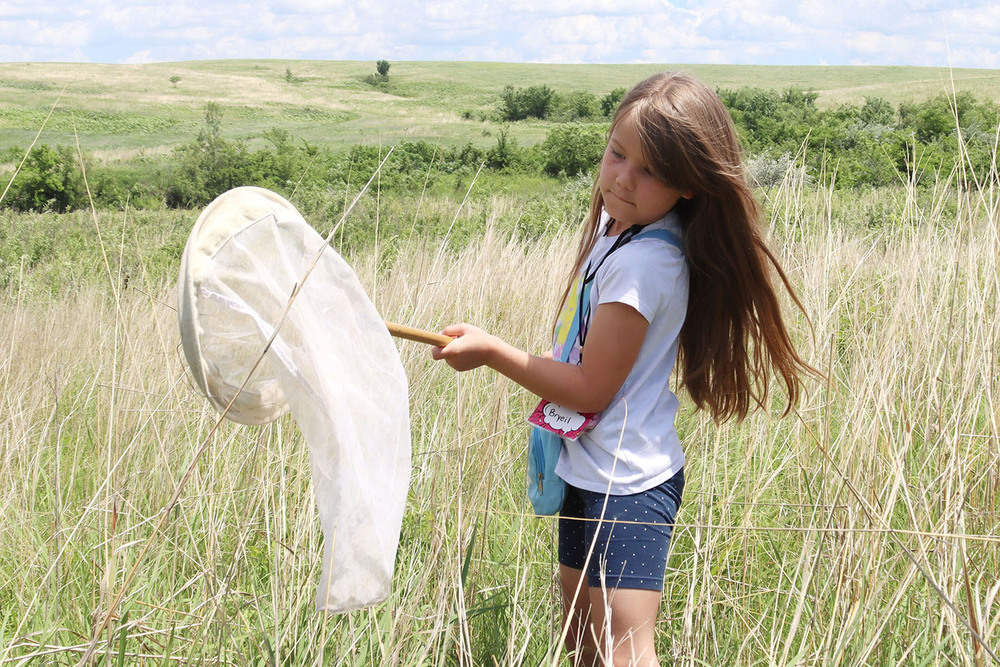
Stella and Violet beamed this summer when they discovered three potato beetles had become lodged in their tallgrass prairie insect net.
The Lincoln Public Schools fourth graders were part of an educational expedition at Spring Creek Prairie Audubon Center. Forty-one elementary students hunted for insects, tracked down aquatic creatures and learned how birds use their beaks during the afternoon. The field trip was one of five activities the group participated in during the weeklong American Indian Summer Fun Camp.
Stella and Violet caused a buzz of excitement after they swooped their large net through pristine tallgrass prairie. They smiled after seeing three strange bugs at the bottom of the meshwork, and their interest grew even more after their guide said she had never seen that type of insect before. The group hustled back to Spring Creek Prairie’s main educational center to identify what the LPS students had captured.
“It was exciting because we found something that they didn’t know about,” Stella said. “It was a new thing for everyone.”
“It was different because I’ve never caught one before, and I didn’t know what it was,” Violet said. “It was cool.”
Meadow Lane Elementary School fifth grader Ravyn showcased that same joy during a presentation about local birds. She gazed in amazement at the beak of a great horned owl and correctly identified a woodpecker beak in front of the group. She said it was fun to learn more about the prairie’s airborne residents.
“I love birds,” Ravyn said. “I was named after a bird, so it’s something I’m interested in.”
Jason St. Sauver said those breakthrough moments were music to his ears. St. Sauver has helped hundreds of students become more familiar with nature in his role as Spring Creek Prairie’s education manager. The 1,160-acre tallgrass prairie preserve features 235 bird species and 370 types of plants.
St. Sauver said it was essential for younger students to learn about ponds, prairies and potato beetles up close. Stella, who attends Belmont Elementary School, and Violet, who attends Humann Elementary School, experienced a grasslands environment not found within city limits. The trip exposed them to subjects like botany, zoology and entomology and gave them a greater appreciation of science overall.
“A lot of times we think that places like this are accessible to everyone, but they’re not,” St. Sauver said. “That’s why it’s so important for them to come here. You saw the smiles on their faces. It was awesome to be able to work with them here today and show them how important these ecosystems are. I think they learned a lot.”
Education was the primary goal of the camp, which gave American Indian students opportunities to visit places in both Lincoln and Omaha. They traveled to the Kiewit Luminarium, Lincoln Indian Center, Morrill Hall, Spring Creek Prairie Audubon Center and Holmes Lake Park throughout the week. The indoor and outdoor activities focused on scientific, historical and cultural topics.
Joe Rousseau is the LPS American Indian Demonstration Grant coordinator. He said the Spring Creek Prairie field trip served several purposes. It gave students a chance to discover new facts about nature and form stronger friendships with each other.
“It’s important for our children to be able to spend time with their relatives so that they know that we are not alone and that we’re able to take care of each other,” Rousseau said.
Ravyn said she enjoyed learning a variety of lessons with fellow campers. She especially liked the bird presentation by Brady Karg, who is Spring Creek Prairie’s education coordinator. He showed students a picture of a woodpecker’s long tongue to illustrate how the bird reaches insects in trees. The photo astonished everyone gathered around him.
“It’s as long as a giraffe,” Ravyn said.
Community engagement was also a primary objective. Students fished together at Holmes Lake Park, solved scientific puzzles at the Luminarium and strengthened bonds with lunches outside Morrill Hall. They also became the first LPS group to use a new basketball hoop at the Indian Center.
Violet said the opportunity to form friendships is one of the best parts of the camp. She and Stella quickly bonded during bus rides to and from the different activity locations. She also reunited with people she had met during previous summer camps.
“It’s really fun to do this with friends,” Violet said. “I make new friends every single year.”
St. Sauver saw those relationships pay off when he guided an energetic group down a walking trail to a small pond. After watching him explain how to properly use a net along the shoreline, students teamed up to see what they could capture from the water. Their partnerships soon yielded tadpoles, small frogs and damselflies that they deposited into an inflatable tray.
“I love everything about this job, but one of the best parts is seeing how excited the kids get when they experience something for the first time,” St. Sauver said. “You see that light in their eyes when there’s something they haven’t seen before.”
Students attended all activities free of charge through an American Indian Demonstration Grant Fund. They received bucket hats to wear during their time at Spring Creek Prairie, and they enjoyed hot dogs and hamburgers together while at Holmes Lake.
Violet said she would recommend the camp to all American Indian students interested in making both friendships and academic memories.
“We get to go somewhere different every day,” Violet said. “It’s been a lot of fun.”
Discover more about the academic and prosocial lessons that students learn from LPS Federal Programs each year.
Do you have a story idea? Share it with the LPS Communications Team by filling out this form!