
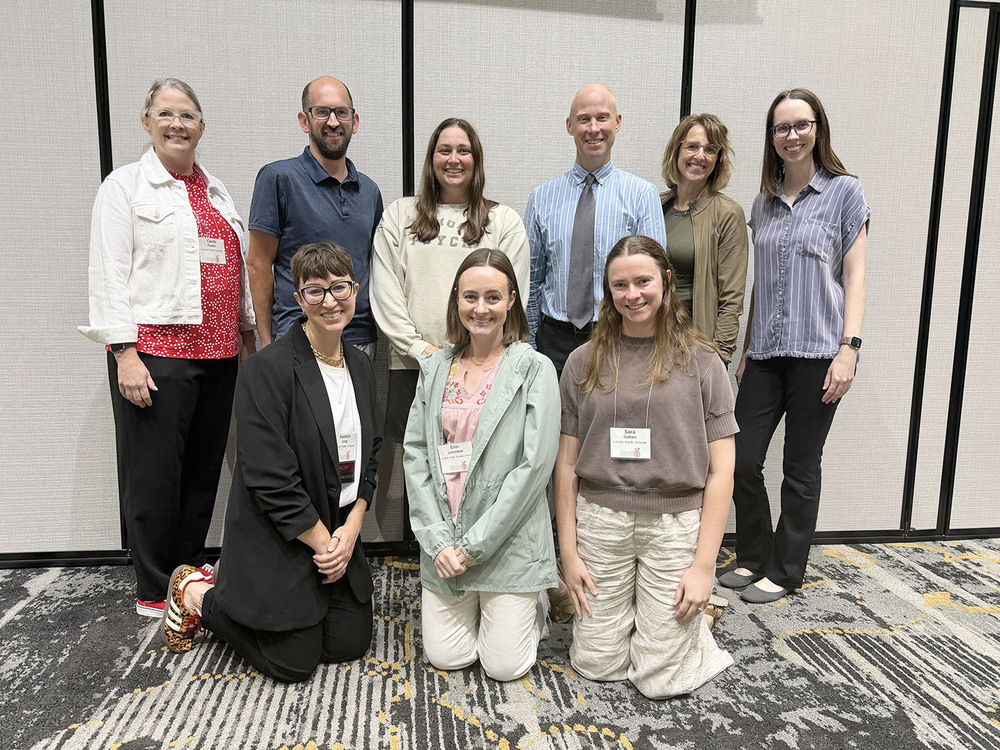
Five Lincoln Public Schools Special Education Department staff members shared their educational expertise with fellow professionals from a 500-mile area this fall.
Katelyn Voigt, Troy Baker, Philip Rohde, Emily Ediger and Missy Sears delivered presentations at the Nebraska School Psychologists Association (NSPA) Fall Conference. They spoke about supporting students with attention-deficit/hyperactivity disorder (ADHD) and autism spectrum disorder (ASD). School psychologists from across the state listened to their research, conclusions and suggestions in Kearney.
LPS Special Education Supervisor Carrie Foster said she was proud to watch everyone handle leadership roles at the conference. She said they demonstrated how LPS staff members help children through positive, evidence-based practices.
“I loved seeing the group highlight the incredible work happening across LPS and take pride in sharing their inclusive practices with their peers,” Foster said.
Voigt, Baker and Rohde are school psychologists, Ediger is a speech-language pathologist and Sears is an occupational therapist at LPS. Voigt is the school psychologist team leader at Southwest High School, Baker works at Scott Middle School and Rohde helps elementary students at Calvert and Clinton. Ediger works at Pyrtle Elementary School and assists non-public students in her LPS role. Sears provides occupational therapy for pupils at East High School, Pound Middle School, Pyrtle and Robinson elementary schools and non-public buildings.
Voigt, Baker and Rohde led a presentation entitled “Using a Multi-Tiered System of Support to Determine Eligibility for Students with Characteristics of ADHD.” They focused on Nebraska Rule 51, which lists state regulations and standards that all special education programs must follow.
The trio addressed recent changes to Nebraska Rule 51 guidelines about other health impairment (OHI) eligibility. The state no longer mandates written documentation for OHI eligibility.
Voigt, Baker and Rohde helped the audience learn practical ways to evaluate and support students. Some children may display ADHD characteristics in the classroom without having received a formal medical diagnosis.
“The ADHD presentation showcased our school psychology team’s effort to make OHI verification more equitable,” Foster said. “Katelyn, Troy and Philip shared how removing the medical diagnosis requirement ensures better support for families without easy access to healthcare.”
Rohde said it was fulfilling to work on the presentation with Voigt and Baker.
“I really enjoyed being able to share what LPS has been working on in the past few years to create better systems for students,” Rohde said. “It is great to be able to collaborate with fellow LPS psychologists to put together a session that we feel will be helpful to other school psychologists across the state.”
Voigt, Sears, Ediger and Baker led a presentation entitled “Neurodiversity-affirming Framework for Supporting Students with ASD (autism spectrum disorder) in Special Education.” Students with ASD may learn, communicate and behave in ways that are different from other people.
The four professionals explained how LPS established a needs assessment tool for educators to use. They showed how the tool is a practical method for determining eligibility and creating individualized education plans (IEPs) for students. This has led to more beneficial teaching strategies that have helped children with ASD succeed at school.
The presentation also highlighted the cooperative efforts of a committee that developed the needs assessment tool. The group included school psychologists, speech-language pathologists, occupational therapists and special education teachers.
“I’m really proud of our team because we saw a need and took initiative to update some of our systems to a more neurodiversity-affirming approach, and it has led to district-wide changes in how we evaluate and program for these students,” Ediger said. “The way we talk about students in meetings and our reports matters, and having a strengths-based, neurodiversity-affirming perspective has made a huge difference for the students I work with. I hope those listening to our presentation were also able to see that and reflect on their own practices.”
“I think it is important for other school psychologists across the state to see that creating high-quality and accurate assessments and educational programming for autistic students requires a multidisciplinary approach,” Sears said. “Helping others understand the needs of neurodivergent students in the school environment is incredibly beneficial for their overall success, confidence and general well-being.”
Rohde and Voigt said they also reaped valuable benefits from the educational connections they formed with other state leaders at the conference.
“It is so important to be able to connect with friends and colleagues from districts all across the state,” Rohde said. “The conference provides the opportunities to swap ideas, share in the joys and frustrations that are common no matter what part of the state one resides, and to learn from different presenters to improve our service delivery.”
“What I enjoy most about participating in the Nebraska School Psychologists Association Fall Conference is getting the opportunity to not only showcase the incredible work we are doing within Lincoln Public Schools, but also to learn how other school districts are approaching complex problems that impact all of us across the state of Nebraska,” Voigt said. “NSPA is dedicated to providing a platform to elevate practitioner voices.”
Voigt said state and national conferences allow everyone to grow together in the fields of school psychology and special education.
“Attending professional learning for school psychologists at both the state and national level allows me to return to LPS with a renewed sense of purpose for the work we do, a profound respect for the impact special education has on the lives of our students, a few more tips and tricks to hide up my sleeve, and an elevated sense of pride in the amazing things happening right here in LPS,” Voigt said.
Discover how our special education team helps students achieve success in their classes.
Do you have a story idea? Share it with the LPS Communications Team by filling out this form!

