CASNR partnership helps Rockets reach new scientific frontiers
April 13, 2026
Northeast High School students expanded their arteries of academic knowledge this semester by studying fresh specimens of animal organs.
Members of the Medical Terminology course dissected pig hearts during a hands-on activity in their science laboratory. A partnership between Lincoln Public Schools and the University of Nebraska-Lincoln’s College of Agricultural Sciences and Natural Resources (CASNR) made the experience possible for the Rockets. Pig hearts are valuable to study in medical classes because they are similar in size and function to human hearts.
Northeast senior McKinley spent the morning working at one of the science lab tables. She and her lab partners used scalpels and scissors to examine the pericardium, myocardium and ventricles of their hearts. She said it was fun to get a firsthand look at fresh tissue.
“I really enjoyed how you got to be hands-on and see inside the heart and get to look at everything inside it,” McKinley said. “You didn’t have to worry about messing anything up or getting anything wrong. You just had freedom to explore and learn.”

At another table, lab partners Lauren and Camden marveled at the details that they found in their organ. They carefully peeled back layers of tissue to inspect blood vessels and cardiac muscles. It was the first time either of them had investigated something as large as a pig heart.
“The intricacy of the heart was just really cool to dig into,” Camden said. “It was neat to look at all of the pieces and parts.”
“Seeing the different structures and how everything works together to make a functioning system was really fun,” Lauren said. “I liked doing this.”

Northeast science teacher Ellen Odson has been guiding LPS students since 2011. She said the pig dissection lesson was a valuable teaching tool for many Rockets. McKinley is planning to work in surgical technology after graduating from college, and Lauren and Camden are both interested in pursuing similar medical careers.
“I think it’s good for students who are going into the medical profession to see how well they handle a fresh specimen,” Odson said. “A lot of them have maybe done smaller dissections in middle school, but they haven’t had anything that wasn’t preserved. We got these specimens last week from UNL, so to have something where it can come from the animal to us so soon isn’t something that happens a lot in a high school lab.”
Northeast received fresh pig hearts thanks to the expanded partnership between LPS and CASNR. LPS/CASNR Early College and Career Pathways Coordinator Bailey Feit works with LPS curriculum specialists on food, energy, water and societal systems (FEWSS) topics. She then provides CASNR-based lessons that help students at all LPS buildings reach their college, research and career goals.
Odson said the agreement has given the Rockets world-class academic opportunities. Feit brought a cow heart from the UNL Animal Science Meat Laboratory to students this past fall, and she secured five pig hearts from the university for this spring’s Medical Terminology class.
Pig hearts are the most commonly dissected mammalian hearts. Pig and human hearts both contain four chambers, four valves and an aorta, which makes them ideal for studying the human circulatory system.
“Having Bailey be able to communicate and partner with UNL to say, ‘Hey, this is what I have available. What works for you?’ is really, really nice,” Odson said. “We’re not having to rely on finding specimens from other places.”


Odson said students were also able to learn more scientific material by working on fresh specimens. Preserved animal organs are embalmed and often have stiff and discolored tissues. Fresh organs offer superior tissue flexibility and showcase accurate colors and textures, which help people learn more about their true nature.
“A lot of times, high schools work with preserved specimens,” Odson said. “That would have been an option, but it’s a very different experience for the students.”
McKinley felt the advanced dissection would give her a good head start on college. She was happy to discover many noteworthy features as her team worked through the heart’s layers.
“There were a lot of surprises,” McKinley said. “Some of the different textures surprised me for sure. The smell was weird, but other than that, it was really fun.”
Feit said those reactions are why she likes working with LPS students. She encouraged each group as she watched them uncover medical information in real time.
“A lot of them have never been able to touch real tissue and muscle before,” Feit said. “I think a lot of them were surprised by how tough it was to cut open. They might see television shows or YouTube videos of a doctor just slicing right through thick skin, and it looks so easy. For them to have a chance to actually feel that experience is really eye-opening for them.”
Odson said she believes the CASNR partnership will convince even more Northeast students to consider enrolling in future science courses.
“It’s a selling point for us,” Odson said. “There aren’t a lot of other classes that get to do hands-on things like this with fresh animal specimens.”
Explore more ways that LPS science classes equip students with vital skills and information.
Do you have a story idea? Share it with the LPS Communications Team by filling out this form!
Published: April 13, 2026, Updated: April 13, 2026
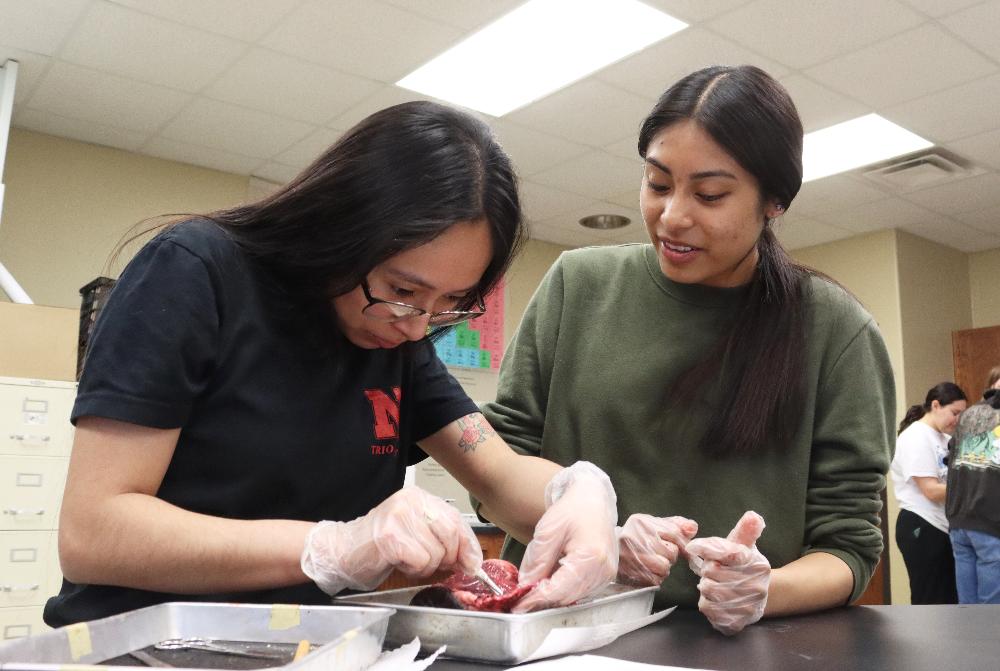
From left, Northeast High School students Claudia and Daniela work on dissecting a pig heart in their Medical Terminology class. Many Rockets explored ventricles, arteries and chambers of the hearts, which gave them new insights into the medical world.