Grasping Genetics: Park students learn about genetic traits by tasting apples
May 18, 2026
Park Middle School sixth graders gained scientific insights this spring by taking tasty bites of apples at their desks.
The Panthers explored the genetic makeup of four apple types during their Science and Design Thinking course. They tested the traits of Honeycrisp, Gala, Red Delicious and Golden Delicious apples before comparing their findings with their classmates. That laid the foundation for higher-level discussions about how genes cause different amounts of color, texture, flavor, crispiness and juiciness.
Eevy and Jai’Lisea said the experiment gave them a clearer understanding of why genetics matter for researchers, scientists and apple eaters.
“Doing projects like this is fun because it gives people a visual of what we’re learning,” Eevy said. “It makes it real.”
“I liked eating the apples because we got to taste all of the different flavors of apples that there are,” Jai’Lisea said.


Park science teacher Dave Beatty said Lincoln Public Schools students like Eevy and Jai’Lisea learned many scientific principles from their fruit fact-finding missions. Apples contain approximately 57,000 genes, which is twice the amount found in humans. These genes create characteristics such as disease resistance, texture, size, color and aroma.
“They have to ask really thoughtful questions like, ‘How do apples get their traits?’ and ‘Where do those come from?’” Beatty said. “Ultimately, everybody’s had a little bit of experience with genetics when people talk about your parents’ eye color or hair color, but this is where we really turn that into, ‘Well, crispiness is a trait, and it’s on a gene.’ It’s probably the most complicated science that they’ll do this year.”
The Panthers were part of an apple-based initiative that took place at all 12 LPS middle schools. LPS K-12 Science Coordinator Miranda Orellana and LPS Assistant to Science and Math Laura Buis worked with LPS Nutrition Services staff to finalize this year’s project. LPS Nutrition Services purchased 2,312 apples for sixth graders to use. Employees then distributed them to each building in time for the big day.
Beatty was part of a five-person team of LPS teachers who created the apple genetics unit. Shannon Binkley (Mickle Middle School), Lindsey Brown (Irving), Mallory Davis (Pound) and Jason Wunderlich (Park) shared their scientific expertise in the curriculum drafting process. LPS also partnered with the University of Nebraska-Lincoln College of Agricultural Sciences and Natural Resources (CASNR) and Nebraska Farm Bureau.
“It’s really exciting when you have this many people coming together to develop this type of curriculum,” LPS Science Curriculum Specialist Betsy Barent said. “It’s fun to be able to write lessons like this. These teachers and these partners made something that I think the students are going to remember for a long time.”


The apple activity was the latest in a long string of genetics-based lessons for sixth graders. All LPS students are first introduced to the concept of genetic traits in first grade through a butterflies unit. They build on that understanding by studying flamingos and chickens in third grade and moonflowers in fourth grade. Those steps continue into high school biology classes, where they investigate the microscopic and macroscopic influences of traits and inheritance to explain natural phenomena.
Barent said it is important for the LPS science curriculum to have unified themes through each grade level.
“I liken this to an energy concept in science,” Barent said. “It takes more energy to get a process started than to keep it going. We want learning to not be starts and stops, but a continuous journey that our students are able to make connections to through their time at LPS and beyond.”
Small groups of Panthers began their experiment by sampling all four apple varieties. They then ranked each apple trait on a scale of one to five. They recorded their results in notebooks and discussed them with their teammates.
“I liked how we were able to taste the apples with our friends and see how different our tasting abilities are,” Olivia said. “It was fun to do.”
“Some tasted like you wouldn’t expect them to,” Eevy said. “There were a couple of them like that.”
Beatty then gathered everyone together for an in-depth conversation. Many Panthers compared their apple flavors to water, apple juice and applesauce, while others said the texture was like grains of sand. The class voted the Honeycrisp variety as its favorite apple.


Students were surprised to learn about the role of genetics in Honeycrisp apples. Scientists at the University of Minnesota Horticultural Research Center planted the original seedling in 1962 after cross-pollinating Macoun and Honeygold varieties. The university released it to consumers in 1991 after a lengthy genetics process, and its popularity soon began to soar. The U.S. Apple Association estimates that 34 million bushels of Honeycrisps will be sold in the 2025-26 crop year.
Another student told Beatty after class that he thought Cosmic Crisp apples were even juicier than Honeycrisp, which he traced back to Cosmic Crisps having different genes. Beatty said that was an illustration of how the Panthers applied their new knowledge in real time. It also showed why plant genetics are an important topic for them to study.
“The new hybrids are responses to what people like,” Beatty said. “Ultimately, it’s a business and a farming and a genetics decision.”
Jai’Lisea said she has enjoyed sixth grade science because of projects like apple tasting. She was interested in investigating other fruit varieties to learn about their genetic backgrounds too.
“All of the units so far have been fun,” Jai’Lisea said. “Nothing’s been boring, and I think I’ve learned a lot.”
Beatty said those responses are why he feels so strongly about the value of public education across the United States.
“I think there’s no more important structure in society than public education, and this is something hands-on that shows that,” Beatty said. “Most of the science we do always has a hands-on component to it. It’s doing the experiments, it’s collecting the data, it’s all of that.”
Discover how science projects like apple testing make awesome impacts for LPS students.
Do you have a story idea? Share it with the LPS Communications Team by filling out this form!
Published: May 18, 2026, Updated: May 18, 2026
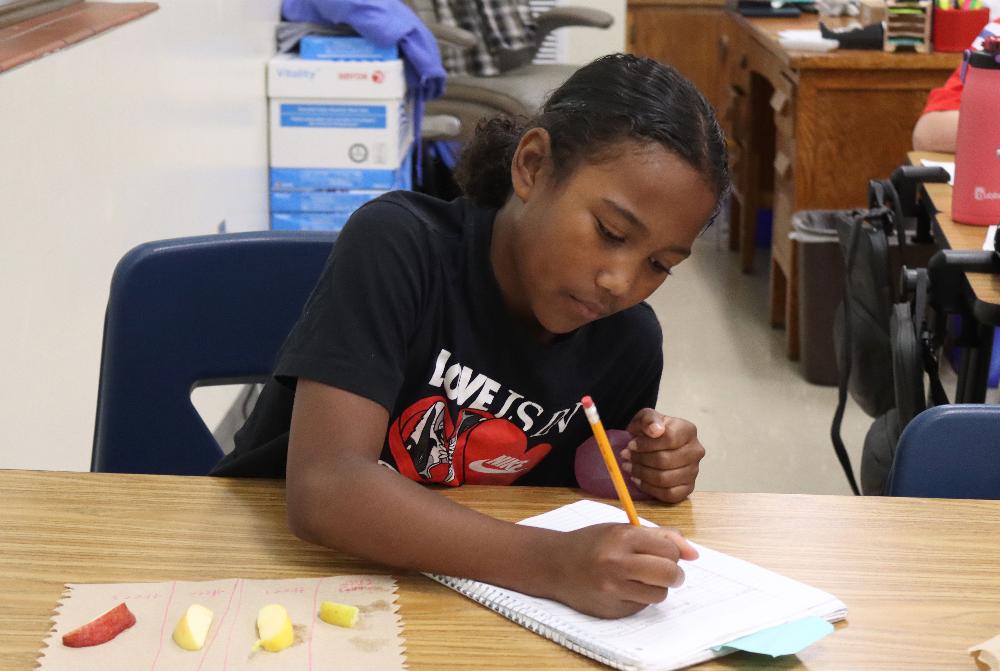
Park Middle School sixth grader Jai'Lisea writes information in her notebook about her apple tasting experiment. Students learned about genetic traits by noticing the similarities and differences of four apple types in their science class.