Fredstrom students pocket popcorn knowledge during special presentation
March 16, 2026
Learning popped into the minds of Fredstrom Elementary School second graders this winter when they listened to a professional popcorn farmer.
Sutherland farmer Roric Paulman shared his four decades of agricultural knowledge with the Falcons as part of an elementary science unit. He gave them corn cobs to pass around, provided bags of finished popcorn and walked them through the entire planting and harvesting process.
Emma said she liked listening to Paulman with her entire class. She said the presentation inspired her to think about growing her own popcorn in the future.
“I think it’s going to help me if someday I want to be a farmer,” Emma said. “I’ll know what to do to help me be a farmer.”


Kalen said he was impressed with the fact that there are multiple types of popcorn. Kernels are available in yellow, white, red, blue and purple colors, and they can be popped into varieties such as butterfly, mushroom and ladyfinger.
“I learned what different popcorns there are,” Kalen said. “I thought there was just one.”
Paulman said he was happy to make the six-hour drive to Lincoln from his family farm. His operation grows multiple crops on 8,500 acres each year, including 28 million pounds of popcorn. He said it was important to teach students about science and agriculture with memorable and interactive lessons.
“This was fun,” Paulman said. “I enjoyed it.”
All LPS second graders will watch a recording of Paulman’s visit when they explore popcorn in their own science classes. The video will help them learn more about the crop and how it impacts the state.
LPS K-12 Science Curriculum Coordinator Miranda Orellana said the presentation gave students a chance to extend their classroom knowledge. LPS has partnered with the University of Nebraska-Lincoln’s College of Agricultural Sciences and Natural Resources (CASNR) for food, energy, water and societal systems (FEWSS) lessons.
“LPS Science has a partnership with the FEWSS program through CASNR, which has a direct connection to Mr. Paulman,” Orellana said. “We discussed the opportunity of bringing in a real popcorn farmer who could share his story and answer questions from students who are learning about the crop he grows.”


Popcorn is one of more than a dozen “anchoring phenomenon” topics that Lincoln Public Schools elementary school students will investigate in their careers. The goal is to use easy-to-recognize subjects like butterflies, Chimney Rock, flamingos and ocean waves to connect them to larger scientific principles.
LPS second grade teachers Molly Moller (Sheridan Elementary School), Kennedy Simpson (Prescott), Lori Jacoby (Norwood Park) and Caitlin Lam (Pershing) created the popcorn unit in the summer of 2024. They spent four days writing ten lessons about the scientific properties of matter like solids, liquids and gases. They weaved the anchoring phenomenon of popcorn into all of their materials.
Moller, Simpson, Jacoby and Lam built popcorn-themed slides, student notebooks and vocabulary cards for a pilot program in the 2024-25 school year. Simpson and Moller then took feedback and wrote two additional lessons the following summer. They designed the extra sessions to extend students’ understanding of the concepts of reversible and irreversible changes, parts of a corn kernel and how adding heat changes each kernel.
Moller said she has been pleased with how LPS students have responded to the unit.
“I think students have learned that not all corn is the same,” Moller said. “When you add heat to a popcorn kernel you get popcorn, but when you add heat to other kinds of corn, you do not get popcorn.”
Rochelle Settles has been teaching for 31 years and is currently the science specialist at Fredstrom. She said popcorn provides a perfect illustration of how matter can change in different environments. Each kernel contains a tiny amount of water that expands when heated. The resulting steam pressure eventually causes the hard starch surface to burst and the soft interior starch to inflate.
“I think popcorn is easy for students to understand that connection,” Settles said. “They investigated all of those parts that were in the popcorn, and they could see why those parts contributed to that popcorn popping, but other kinds of corn don’t.”
Paulman shared many other agricultural facts with the Falcons in the school cafeteria. Nebraska is home to more than 25 percent of the national popcorn production, and hailstorms are the top peril to his crops each summer. He uses a high-tech combine that is 40 feet wide and can show him in real time how much he is harvesting.
“It was a really good presentation,” Emma said. “I liked it.”

The second graders then practiced their community engagement skills during a question-and-answer session. They asked Paulman how long it takes to harvest his crops (approximately one month), what shape a popcorn kernel is (rounded) and how to quickly count kernels on a corn cob.
Students were also interested in the financial aspects of his business. Paulman told them a semi-autonomous combine costs $1 million, tractors are $500,000 apiece and grain carts are $150,000. Alex and other Falcons looked on with awe as they tried to comprehend those numbers.
“I didn’t know it’s so expensive just to buy combines,” Alex said.
Settles said she was proud of students for asking thoughtful questions to Paulman. She said their detailed requests showed that they had been paying attention during both the popcorn unit and his presentation.
“They had some really amazing questions today,” Settles said.
Settles said these types of interactive lessons are helping students develop an inquisitive mindset for a lifetime of education.
“When they go to the grocery store, it’s important for them to know where these products come from and how important Nebraska is in producing those crops that eventually become their food,” Settles said. “I think this is very impactful for their learning.”
Learn how the LPS science curriculum helps students produce a bumper crop of knowledge.
Do you have a story idea? Share it with the LPS Communications Team by filling out this form!
Published: March 16, 2026, Updated: March 16, 2026
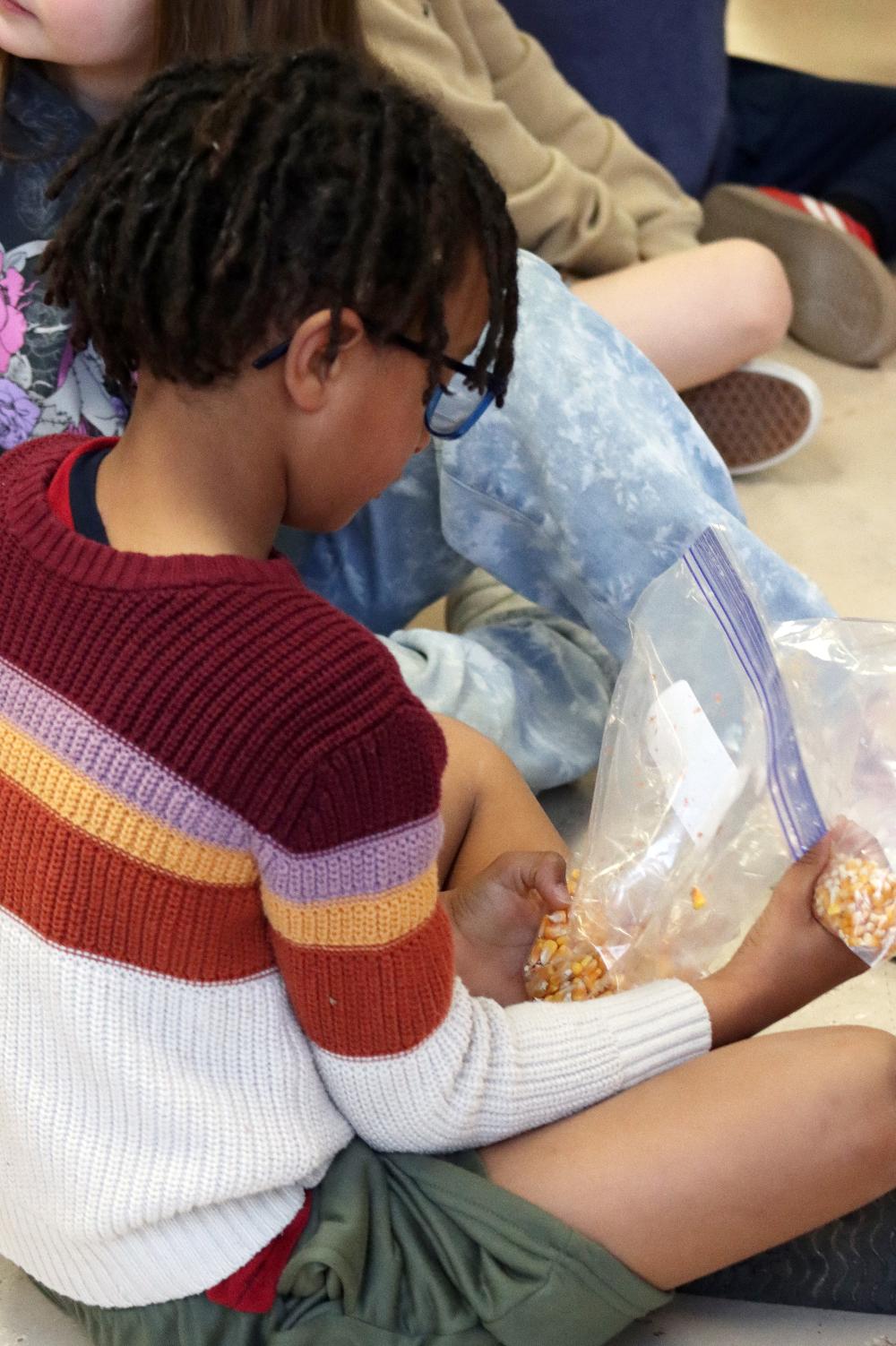
A Fredstrom Elementary School student inspects a bag of unpopped popcorn kernels during a science presentation at school. Popcorn farmer Roric Paulman shared his four decades of agricultural knowledge with students as part of a science unit.